

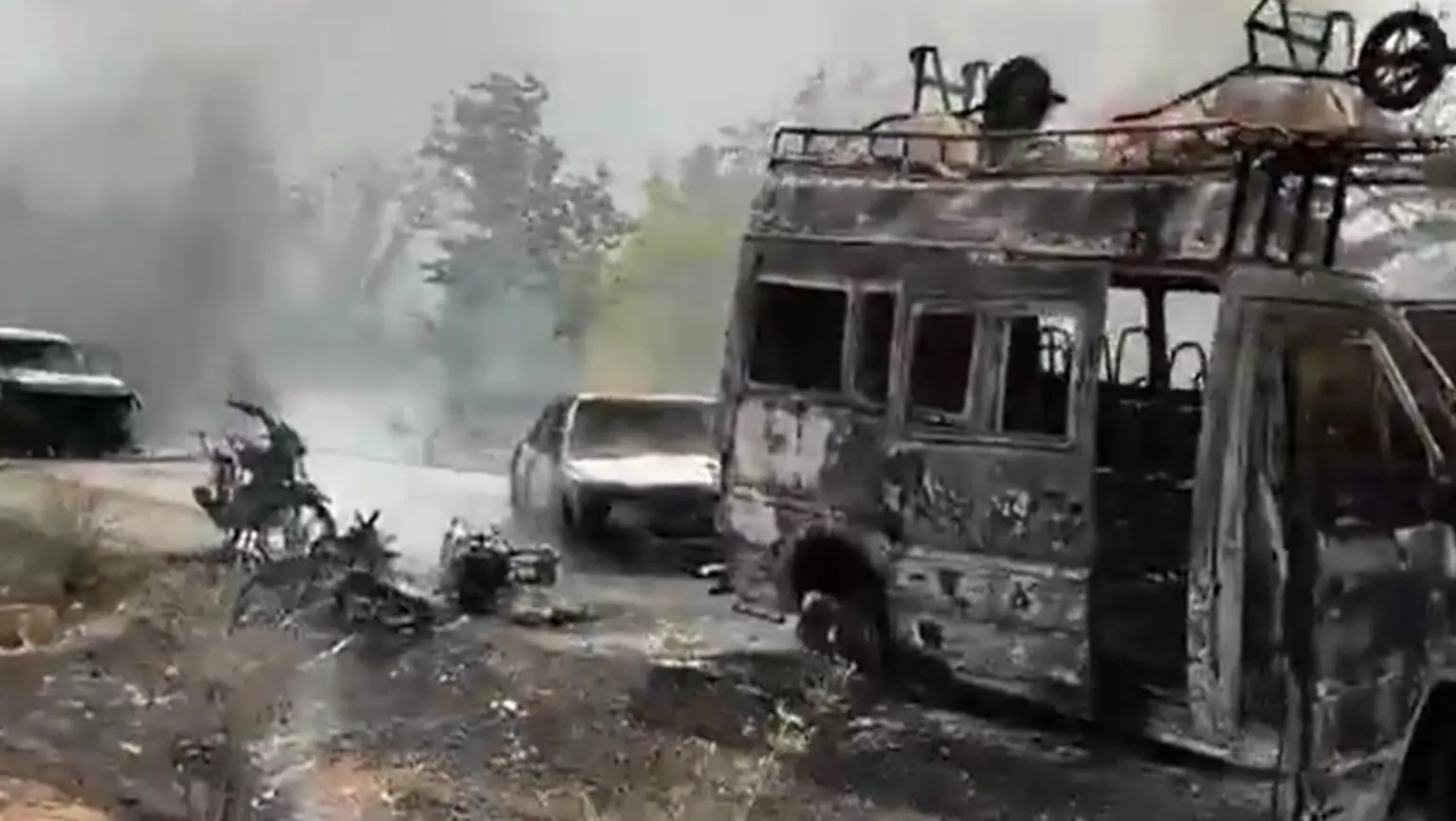
Dozens of vehicles, including fuel tankers, minibuses, and trucks, have been set on fire near Mali’s capital, Bamako, as jihadists intensify a blockade of the city, the BBC has confirmed. Videos filmed from passing vehicles and verified by the BBC show the charred remains of the vehicles on a road approximately 45km (28 miles) west of Bamako. There are no reports of casualties; those on board were reportedly asked to exit before the vehicles were set ablaze.
Jama’at Nusrat al-Islam wal-Muslimin (JNIM), a jihadist group affiliated with al-Qaeda, imposed a fuel blockade on Bamako last year, which it intensified after attacking the city last month. The BBC has contacted Mali’s government for comment. Mali is a landlocked country and heavily relies on fuel transported from neighboring coastal countries such as Senegal and Ivory Coast. The militants have kidnapped drivers and burnt more than 100 fuel trucks on major highways in the country since last year, though some have managed to reach Bamako under military escort.
Impact on Eid al-Adha and Prices
The blockade is causing shortages and sharp increases in the prices of many goods ahead of the Islamic holiday of Eid al-Adha, which is scheduled for next week. In the latest attack, BBC Verify authenticated the videos by matching two distinctive buildings on the side of the road to satellite imagery and checking for AI manipulation. NASA’s satellite-based platform FIRMS – which detects heat sources on Earth’s surface – also detected a heat signature at the same location on Tuesday. Experts state that the fuel blockade is intended to suffocate Mali’s economy and weaken the legitimacy of the military leaders in power.
Government Response and Foreign Involvement
Mali is currently led by Gen Assimi Goïta, who first seized power in a coup in 2020, promising to restore security and repel armed groups. He has invited the Russian paramilitary group Africa Corps, which evolved from the Wagner Group, to assist in fighting the Islamist insurgents. In January, he appointed 47-year-old Brig Gen Famouké Camara to lead a special operation to counter the fuel blockade, but attacks on fuel convoys have persisted. Before the latest attack, the fuel crisis resulting from the blockade had appeared to be easing. The Africa Corps has been assisting in getting supplies into Bamako. The BBC has verified footage of Russian attack helicopters escorting convoys, including fuel tanks and heavy goods trucks, along roads to the capital. The Africa Corps has posted daily videos on social media for the past few weeks, showing troops on patrol. Analysts suggest this publicity blitz aims to combat criticism of their failure to halt the rebel advance. The Kremlin has pledged that Russian forces will remain in Mali to fight ‘extremism, terrorism, and other negative manifestations’.
When the jihadists imposed a fuel blockade last year, it caused shortages and a sharp increase in prices in the capital. Last month, they ordered a total blockade, leaving residents concerned. Eyewitnesses told the BBC at the time that at least three of the six main routes into the city would be closed for hours at a time, and while the fighters moved elsewhere, some vehicles would manage to slowly pass through. This partial blockade has led to high costs for basic commodities. One man stated that a kilogram of potatoes, which used to cost 350 CFA francs ($0.62; £0.46), now costs 500 francs ($0.90). ‘Everything in the market has become expensive,’ he said.
Ahead of Eid, large numbers of sheep can usually be seen for sale on the streets of the capital of the Muslim-majority country – but this is not the case this year. Muslims are traditionally expected to slaughter an animal to commemorate Prophet Ibrahim’s willingness to sacrifice his son Ishmael as an act of obedience to God’s command. If affordable, every Muslim family in Mali attempts to purchase an animal for slaughter during Eid, but this year, the blockade has made it difficult to transport animals to the city. One sheep seller told BBC Afrique: ‘Many people are blocked on the road. People are afraid because they [Islamists] seize the animals.’ As a result, prices have surged. One man told the BBC he could not afford to buy a sheep this year. Instead, he and some friends are considering pooling resources to buy a bull for slaughter. The blockade has also made it risky for people to travel to their home villages during the festive period, as is customary. ‘Traveling would put your life at risk, as well as that of your family,’ said a resident who identified himself as Moussa. ‘I’ve decided to stay and celebrate in Bamako,’ he added.
Historical Context and Ongoing Instability
The junta had popular support when it seized power five years ago, promising to address the long-running security crisis, which was prompted by a separatist rebellion in the north and subsequently hijacked by Islamist militants like JNIM. However, the junta has struggled to contain the deadly insurgency despite the support of Russian mercenaries, rendering much of the north and east of the country ungovernable. Last month, ethnic Tuareg separatists and JNIM launched coordinated attacks on major towns and cities across the country, leading to the death of Defence Minister Sadio Camara after an apparent suicide truck bombing on a residence near the capital.
#MaliCrisis #BamakoBlockade #JihadistAttack #EidAlAdhaImpact #FuelShortage #AfricaCorps #MaliSecurity #JNIM #WestAfrica #EconomicImpact




Leave a Reply