

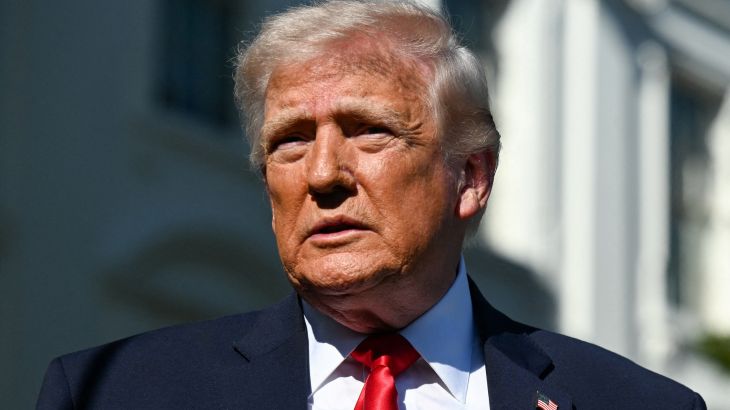
President Donald Trump announced that the United States Navy would commence an “immediate” blockade of the Strait of Hormuz. This decision follows the conclusion of peace talks between the US and Iran in Pakistan, which failed to yield an agreement.
In a Sunday social media post, Trump accused Iran of “extortion” and stated that the US Navy would intercept vessels in international waters that had paid Iran a toll for passage through the strait. He also indicated that US forces would initiate operations to clear mines, which he claimed Iran had deployed in the waterway.
Trump quoted from his post, stating, “So, there you have it, the meeting went well, most points were agreed to, but the only point that really mattered, NUCLEAR, was not.” He further declared, “Effective immediately, the United States Navy, the Finest in the World, will begin the process of BLOCKADING any and all Ships trying to enter, or leave, the Strait of Hormuz.”
The Strait of Hormuz, a crucial chokepoint for the global energy market, has been under Iran’s effective control since February 28, following what the article describes as a war launched by the US and Israel against Iran.
On Sunday, Iran’s Islamic Revolutionary Guard Corps (IRGC) issued a warning, stating that while civilian vessels could traverse the strait under “specific regulations,” military vessels approaching the area would be deemed in violation of the ceasefire and would be “dealt with severely.”
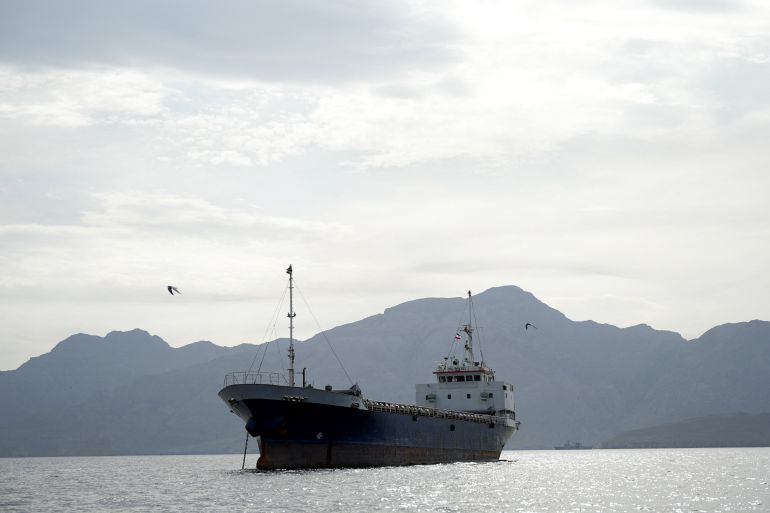
Traffic through the narrow strait has significantly reduced, almost paralyzing approximately one-fifth of the world’s oil and liquefied natural gas shipments and causing widespread economic repercussions globally.
Trump’s recent statements have fueled concerns regarding the stability of the delicate two-week ceasefire.
Al Jazeera correspondent Zein Basravi, reporting from Dubai, United Arab Emirates, characterized the US president’s posts as “very bombastic, very long, very detailed, and seem to be filled with a great deal of frustration.” Basravi added that these developments are undoubtedly raising “alarm bells” within the GCC (Gulf Cooperation Council) nations, which had hoped for the ceasefire to evolve into a sustained, long-term peace, fostering new regional relationships and ending the ongoing violence.
Mediators have consistently urged both sides to prioritize diplomatic solutions and prevent a resurgence of hostilities.
Oman’s Foreign Minister Badr Albusaidi, in a Sunday social media post, appealed for the ceasefire to be extended and for talks to continue. He emphasized, “Success may require everyone to make painful concessions, but this is nothing as compared to the pain of failure and war.”
Iran has refuted US allegations that two of its warships recently conducted mine-clearing operations in the strait, cautioning that any military vessels attempting such actions would face a “strong response.” In his social media post, Trump labeled Iran’s control over the waterway as “world extortion” and issued a stark warning that any Iranian forces firing upon US forces or “peaceful vessels” would be “BLOWN TO HELL.”
Trump further indicated that the blockade would include unspecified “other countries” and vowed to prevent Iran from profiting from the strait’s closure. He reiterated in his social media post that the US Navy would intercept “every vessel in International Waters that has paid a toll to Iran.”
In a subsequent interview with Fox News on Sunday, Trump stated, “We’re not going to let Iran make money on selling oil to people that they like. It’s going to be all or none, and that’s the way it is.”
He also mentioned that the United Kingdom and “a couple of other countries” are deploying minesweeper vessels to support the US initiative, though this claim has not been corroborated by the British government.
Democratic lawmakers in the US have voiced criticism of Trump’s remarks. Senator Mark Warner, a Democrat, questioned the strategy in a CNN interview, stating, “I don’t understand how blockading the strait is somehow going to push the Iranians into opening it. I don’t see the connection there.”
Since the onset of the conflict, Iran has maintained its own shipping through the strait and permitted a limited number of vessels from other nations to pass. Iranian officials have also explored the possibility of establishing a toll system post-conflict, where users would pay a fee to Iran for transit.
Al Jazeera correspondent Ali Hashem, reporting from Tehran, Iran, highlighted that “Iran knows that controlling the Strait of Hormuz is still their main leverage. The higher the tensions, the more prices surge, and this affects the global economy.”
#StraitOfHormuz #USIranTensions #Trump #MiddleEast #GlobalEnergy #Diplomacy #Ceasefire #NavalBlockade #Iran #InternationalRelations

Leave a Reply