

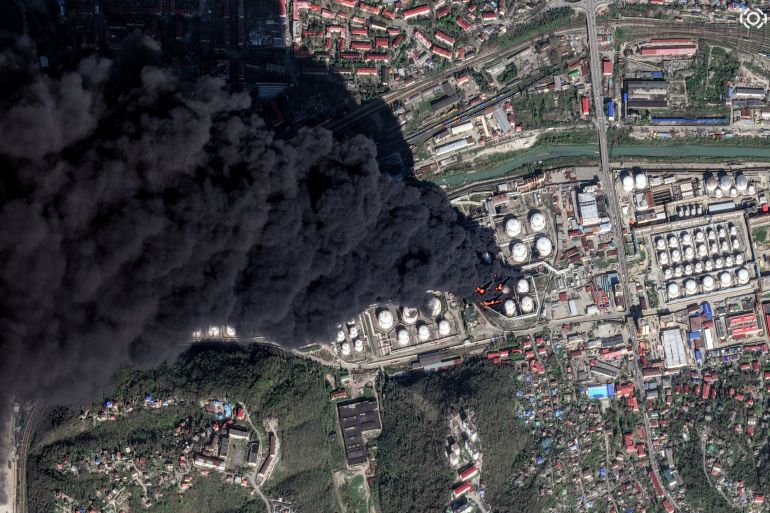
Ukrainian attacks have significantly damaged or destroyed Russian oil and gas infrastructure over the past two weeks, leading Russia to issue a stern warning to European nations and industries. The warning specifically targets those funding Ukraine’s long-range drone production.
This warning follows a series of new agreements Ukraine secured with European defense companies earlier this week.
In a statement on Wednesday, the Russian defense ministry declared, **“We consider this decision to be a deliberate step leading to a sharp escalation of the military and political situation on the entire European continent and creeping transformation of these countries into a strategic rear for Ukraine.”**
Russia further cautioned of **“unpredictable consequences,”** stating that **“the moves of European leaders are increasingly dragging these countries into the war with Russia.”**
The ministry also published a list of addresses belonging to European companies engaged in joint weapons production with Ukraine.
Dmitry Medvedev, former Russian president and deputy head of its National Security Council, later clarified that this list amounted to **“a list of potential targets for the Russian armed forces.”**
The day before, Germany committed to investing **300 million euros ($355 million)** in Ukraine’s long-range strike capabilities, alongside a separate investment in 5,000 mid-range attack drones targeting Russian battlefield supply lines.
Norway also formalized an agreement with Ukraine for joint drone production and donated **560 million euros ($661.5 million)** to bolster Ukrainian front lines with drones.
The Netherlands announced **248 million euros ($293 million)** in drone support, while Belgium pledged **85 million euros ($100 million).**
Putin’s Missing Millions
Reports indicate that the world’s 100 largest oil companies, including Russia’s Gazprom, experienced a **$23 billion windfall profit in March.** This surge was attributed to the Iran war, which has contributed to a global oil supply crisis.
However, much of Russia’s potential windfall has reportedly evaporated due to Ukraine’s persistent strikes targeting its oil export terminals and inland infrastructure.
Reuters reported that Russia has missed out on **40 percent of its potential earnings** because Ukrainian attacks have crippled its capacity to export at least 2 million barrels of oil daily.
These Ukrainian strikes have targeted a diverse range of infrastructure, including drilling platforms, pipelines and their pumping stations, offloading terminals, and refineries.
In the past week alone, Ukraine successfully struck **two drilling platforms in the northern Caspian Sea, two oil pumping stations in Volgograd and Krasnodar Krai, an oil depot in Tver (northwest of Moscow), the Cherepovets Azot ammonia plant in the Volga region, the Sterlitamak Petrochemical Plant in the Republic of Bashkortostan, and the oil export terminal and refinery at Tuapse on the Black Sea.**
All these strikes have been confirmed either by geolocated video footage or by Russian officials.
Ukrainian President Volodymyr Zelenskyy remarked, **“Today, our deep strikes are no longer a sensation,”** highlighting the routine nature of Ukraine’s ability to strike deep within Russian territory.
Deputy Defense Minister Serhiy “Flash” Beskrestnov noted Russia’s inability to produce sufficient air defense systems to protect its vast territory, sharing photographs of improvised Russian air defenses, such as truck-mounted R-77-1 air-to-air missiles.
The Washington-based Institute for the Study of War observed, **“Russia does not appear to have fully developed or deployed mobile fire teams, drone interceptors, or other low-cost distributable systems to defend against repeated massed Ukrainian drone strikes.”**
Conversely, Ukraine’s current strike capabilities are a recent development, acquired only after receiving Western-supplied equipment last year.
On Tuesday, Zelenskyy released a video, now dubbed “Arms Makers’ Day,” which showcased **56 types of Ukrainian-built weapons, including 31 types of drones.**
Former Defense Minister Rustem Umerov, who was pivotal in boosting drone production during 2025, stated, **“Since the beginning of the full-scale invasion, the capabilities of the Ukrainian defence industry have increased by more than 50 times.”**
Ukraine’s Devastating Toll
Ukraine inflicted its most devastating damage on Russian oil infrastructure during the last ten days of March and the first ten days of April. Russia’s oil terminals at the Baltic ports of Primorsk and Ust-Luga were particularly hard-hit since March 22.
Satellite imagery indicated that Primorsk lost **40 percent of its storage facilities**, while Ust-Luga lost **30 percent.** Market sources also reported that Russian energy company Novatek suspended gas condensate processing and exports at Ust-Luga.
Industry sources informed Reuters that both ports were still unable to handle oil shipments as of April 3. Finnish maritime officials further told the agency in early April that shipments from these ports had sharply decreased to **“individual vessels”** from a weekly average of 40 to 50.
On April 5, an Aframax tanker docked at Ust-Luga, marking the first attempt to load crude oil there in many days. However, Ukraine struck the port again that same night, igniting **three 20,000-cubic-meter (706,300 cubic-foot) storage tanks.**
The same day, Ukraine also targeted Primorsk and the oil loading facilities at the Sheskharis oil terminal on the Black Sea, operated by Russian oil major Transneft. Geolocated footage confirmed fires at the oil tanker berths.
Satellite photography suggested offloadings had still not resumed by April 14.
During the attack, Ukraine also reportedly damaged the **Admiral Makarov, a Kalibr missile-carrying frigate.**
An industry source estimated that at least **$200 million worth of oil** was burned in Primorsk.
On April 8, Ukraine struck Russia’s largest oil terminal in occupied Crimea, located at the port of Feodosia. This terminal has been a previous target due to its strategic importance in supplying front lines.
In the first ten days of April, Ukrainian forces also struck Russian refineries in Bashkortostan, located **1,200 km (745 miles) from its borders, and in Nizhny Novgorod.**
Justifying these attacks, Zelenskyy stated, **“Only significant financial losses force Russia to consider a scenario of abandoning this war.”**
#UkraineWar #RussiaUkraineWar #LongRangeStrikes #OilInfrastructure #EuropeanSecurity #DroneWarfare #GeopoliticalTensions #MilitaryAid #EnergySecurity #Zelenskyy






Leave a Reply