

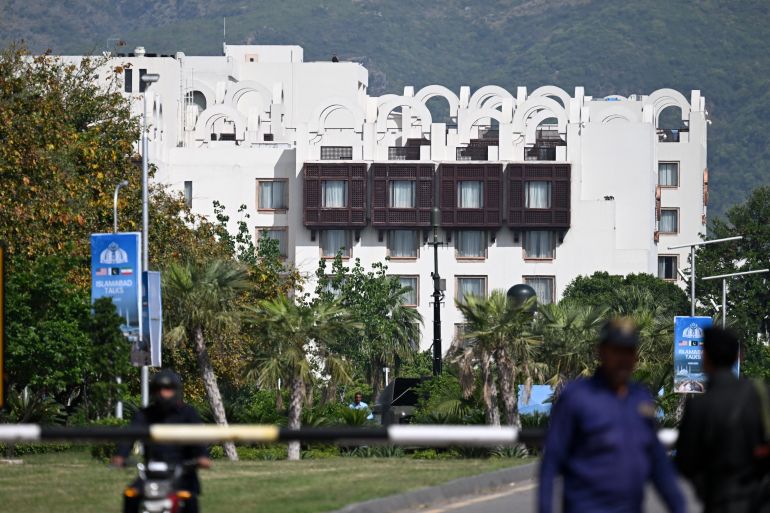
Islamabad, Pakistan – As United States Vice President JD Vance prepares to fly to Islamabad, Pakistan is in a desperate race against time and formidable odds to persuade Tehran to join talks with the US aimed at ending their war, now in its eighth week.
While Pakistani officials involved in the mediation efforts remain cautiously optimistic that Iran might dispatch a negotiating team for the talks by Wednesday, a series of escalatory actions taken by the US over the past 48 hours had, by Tuesday evening, injected a significant dose of skepticism into Islamabad’s peacemaking endeavors.
Iran continues to publicly assert that it has no intention of returning to the negotiating table, even as Pakistan and other mediators work tirelessly behind the scenes to bring Tehran back into discussions before a two-week ceasefire expires on Wednesday evening US time — which is early Thursday morning in the Middle East.
At least nine US aircraft have landed in Pakistan over the last three days, delivering personnel and equipment destined for use by the Vance-led negotiating team.
Vice President Vance is scheduled to depart from the US on Tuesday evening Pakistan time (morning in the US) and arrive in Islamabad late morning on Wednesday. US President Donald Trump’s Special Envoy Steve Witkoff and son-in-law Jared Kushner are expected to accompany Vance. These three officials had previously led the US delegation during the first round of direct talks with Iran in Islamabad on April 11.
However, it remains unclear who they are coming to meet.
Earlier on Tuesday, Iran’s ambassador to Pakistan, Reza Amiri Moghadam, posted on social media, paraphrasing Jane Austen’s Pride and Prejudice, stating that it was “a truth universally acknowledged” that “a single country in possession of a large civilisation will not negotiate under threat and force,” labeling it “a substantial, Islamic and theological principle.”
Iran’s Ministry of Foreign Affairs also stated it had no immediate plans to re-engage diplomatically with Washington. Mohammad Bagher Ghalibaf, Iran’s parliament speaker and head of its negotiating team, was more direct. In a post on X early on Tuesday, he accused Trump of seeking to turn the negotiating table “into a table of surrender or to justify renewed warmongering.”
“We do not accept negotiations under the shadow of threats,” Ghalibaf wrote, adding that Iran had “prepared to reveal new cards on the battlefield” over the preceding two weeks.
Iran’s judiciary chief, Gholamhossein Mohseni Ejei, separately commented that Tehran must “maintain 100% readiness” given a “strong possibility” of further US attacks.
These public statements follow the latest flashpoint between the two adversaries, who have been at war since the US-Israeli attacks on Iran on February 28.
On Sunday, US naval forces fired upon the Iranian-flagged cargo ship Touska in the Gulf of Oman and boarded it after it attempted to pass through a naval blockade that the US has enforced against Iran-linked ships trying to transit the Strait of Hormuz since April 13. Tehran denounced the incident as a ceasefire violation and demanded the immediate release of the ship, its crew members, and their families.
Iran’s Foreign Ministry described the seizure as “extremely dangerous” and “criminal,” warning that Tehran “will use all its capacities” to defend its national interests.
On Tuesday, the US announced that its forces had also boarded a second ship, this time in the Asia Pacific. The vessel, cargo ship M/T Tifani, was already under US sanctions for transporting Iranian oil.
For Javad Heiran-Nia, a researcher specializing in Iranian affairs, the Touska incident may nonetheless present a narrow opening.
“The release of the ship’s crew could be a green light for Iran to soften its position on returning to talks,” he told Al Jazeera.
Umer Karim, an associate fellow at the Riyadh-based King Faisal Center for Research and Islamic Studies, suggested that the principal signal Iran was seeking was an end to the US blockade, or at least a clear intent to relax it.
He pointed to Iran’s conduct during the first round. Tehran had initially conditioned its participation on a ceasefire in Lebanon, before ultimately entering talks without one.
“That shows they are pragmatic,” Karim told Al Jazeera.
Muhammad Khatibi, a political analyst based in Tehran, stated that Iran’s position had been consistent throughout, as Iran believes that as long as it cannot export its oil, it will not permit others in the region to do so either.
A tangible easing of the blockade, he said, did not necessarily need to be publicly announced, as it could take the form of reciprocal steps, “such as the US permitting a number of Iranian oil shipments to proceed, with Tehran responding in kind.”
“Iran does not seek to re-engage in renewed conflict,” he told Al Jazeera. “But from Tehran’s perspective, this is a war of survival, and it is prepared to fight with all available means until the very end.”
**The IRGC Factor**
The statements from Tehran also reflect a domestic political dynamic underpinning Iran’s public posture, according to analysts.
The Islamic Revolutionary Guard Corps (IRGC) has been pressuring Iran’s negotiating team to adopt a firmer stance, they said, conditioning any return to talks on a full cessation of the US naval blockade.
Heiran-Nia noted that the divide between the IRGC and the diplomatic team was evident. He cited instances over the weekend when ships attempting to pass through the strait were allegedly fired upon by Iran. India summoned Iran’s ambassador in New Delhi to express concerns about the firing on two of its ships.
“The attack on tankers during the ceasefire demonstrates the IRGC’s dominance over the diplomatic team and its disregard for their positions,” he told Al Jazeera.
Yet Heiran-Nia suggested that if a deal were reached, it would likely override internal opposition.
“If a deal is reached, it will likely have a sovereign character,” he said. “The establishment will impose its own narrative, and the IRGC will accept it.”
**What Pakistan is Working With**
Trump has set firm public red lines. He has demanded Iran end uranium enrichment and surrender its existing stockpile of enriched uranium. He has stated the US will not lift the Hormuz blockade until Tehran agrees to negotiate.
“They’re going to negotiate, and if they don’t, they’re going to see problems like they’ve never seen before,” he said in an interview on Monday.
The enrichment question remains the central fault line. During the first round of talks, US negotiators proposed a 20-year pause on Iranian enrichment. Iran countered with five years. Trump has publicly stated he wants no enrichment and has refused to set a timeframe for this moratorium.
For Iran, Karim said, the Strait of Hormuz is not simply a bargaining chip.
Tehran is seeking to extract maximum advantage from that leverage before any deal is concluded, he said, because once an agreement is reached, “those cards could no longer be played.”
“Iran understands that it still has leverage,” Karim added, “and that it needs to be utilized to the maximum level in any negotiations.”
Heiran-Nia said Washington’s position on Hormuz was equally entrenched.
“The US wants to remove the Strait of Hormuz card from Iran’s hand,” he said. “Iran, on the other hand, wants not only to preserve it as a negotiating card but also to maintain it as a strategic asset.”
**Trump’s Messaging Problem**
Complicating Pakistan’s efforts is Trump’s public messaging surrounding the talks.
His posts on Truth Social and remarks to reporters, in which he claimed Iran had agreed to provisions that sources said had not been finalized, including the handover of enriched uranium, caused visible strain in diplomatic efforts during the first round.
Iranian officials publicly rejected the assertions, while US media reported that some Trump administration officials privately acknowledged his comments had been detrimental, given Tehran’s deep mistrust of Washington.
Karim, however, said Trump’s messaging was “more a form of posturing than a structural obstacle to the talks.”
Heiran-Nia said how Islamabad frames the process will be critical, regardless of the outcome.
“Pakistan is the only actor that has military and security ties with both Washington and Tehran,” he said, adding that its role in shaping the narrative around any agreement, allowing both sides to claim success, would be “of critical importance.”
**What Comes Next**
A second round of talks, if they materialize, is expected to commence on Wednesday.
Trump has extended the original deadline by 24 hours, stating the truce now ends “Wednesday evening Washington time,” which would be early morning Thursday in Islamabad, and described a further extension as “highly unlikely.” It was initially supposed to end on Tuesday evening in the US, or Wednesday morning in the Middle East.
Whether Iran’s delegation attends remains the central question.
State broadcaster Islamic Republic of Iran Broadcasting said on Tuesday that no Iranian diplomatic delegation, “be it a primary or secondary team, or an initial or follow-up mission,” had traveled to Islamabad.
An Iranian source, however, said there were strong indications that a delegation would still travel to Pakistan, adding that security considerations remained central to any decision.
Heiran-Nia said the consequences of failure in the planned talks would be stark.
“The alternative, return to war, while unable to establish any sustainable balance, promises devastating destruction,” he said.


Leave a Reply