

BBC 7 hours ago Reading time: 7 minutes Amidst the ongoing joint conflict between the US, Israel, and Iran, military expert Akram Kharif has published a book titled “In the Shadow of Witness.”
In the book, he details the design and development of unmanned aerial vehicles (UAVs) in Iran’s manufacturing industry, and explains how Iran became one of the world’s major military powers despite US sanctions.
Information on Iranian drones has been included in reports on the border conflict between Hezbollah in Lebanon and Israel. After some drone wreckage was recovered and thoroughly analyzed, a connection was found between those used by the Houthis in Yemen and those produced in Iran.
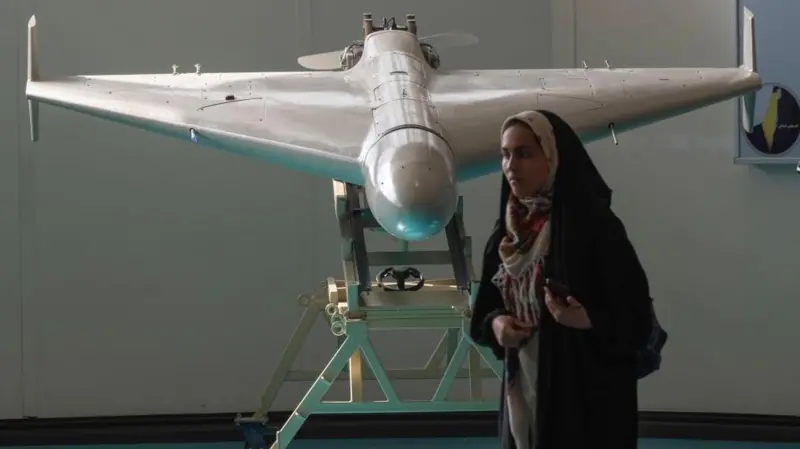
In September 2022, the world was shocked by the news that Iran was supplying military drones to Russia. This followed images of two Shahed 136 drones seen flying in the skies over Kyiv, the capital of Ukraine.
How did a country under sanctions for over 40 years manage to transform its standing in the eyes of the world? What led to this success?
The sanctions imposed on Iran in 1979 forced Iranian leaders to find ways to solve their problems independently to break their dependence. This situation made them rely on domestic manufacturing rather than external aid. As a result of the sanctions, Iran forged alliances with foreign countries to meet its needs. It relied on its indigenous technological capabilities, endured the lack of certain equipment, and demonstrated resilience and determination.
When Mohammad Reza Pahlavi, the Shah of Iran, left the country in January 1979, he left it as the strongest military power in the region. The Iranian Air Force also possessed F-14 Tomcats, F-4 Phantoms, and F-5 Tigers.
At that time, the Iranian military ranked fifth globally in terms of equipment, after the US, Soviet Union, Britain, and France. At this time, the Iranian military was considered stronger than Germany, China, and its rival Israel, as it possessed the F-14 Tomcat fighter jet, which was the most advanced fighter jet in the world at the time.
However, the maintenance of these aircraft depended on the numerous American engineers and technical experts in Iran, and their spare parts were sourced from Grumman in the United States. For these reasons, the aircraft were entirely dependent on the US for their operation.
After the fall of the Shah, most Iranian commanders either fled the country, were killed, or imprisoned. American engineers and technical experts left Iran, and American companies severed their contracts with the new Iranian government.
In September 1980, Iraqi forces attacked Iran, initiating an eight-year war between the two countries. Devastating weapons were used, causing destruction and casualties, including chemical weapons, and approximately one million people were killed during that time.
At the beginning of this war, Iraqi forces had the upper hand due to their superiority. The Iraqi military purchased aircraft from the Soviet Union and used Soviet satellites to track enemy positions and movements.
However, on the Iranian side, its forces fought under difficult conditions and were denied access to reconnaissance and intelligence reports.
Therefore, Iran needed technological advancement to survive among countries that constantly threatened it. The economic sanctions imposed on it prevented it from self-improvement. Thus, they committed themselves to initiating domestic innovation and production instead of relying on external purchases.
A simple idea emerged: If manned aircraft could not be flown to identify enemy positions and movements, perhaps a smaller, remotely controlled technology could perform this task. This technology would be simple, difficult to detect, and provide very useful information.
Starting in 1981, Iranians began contemplating this device and how to equip it with a camera for data collection. This idea originated at Isfahan University, where engineering students voluntarily initiated and implemented it. They first developed a basic prototype before later refining it and presenting it to the country’s leaders.
After years of trials and failures, three young individuals from Isfahan University assembled the device and tested it on a flight in Khuzestan province: a civilian pilot named Farshid, and physics students Saeed and Masoud were involved in the work.
When the test data of the device was presented to the military, some even mocked it. It looked like a child’s toy, perhaps because it was assembled from unusual materials. The fan attached to it was handmade, and the fuel tank was made from a type of hospital IV bag plastic.
In 1983, the underestimated drone traveled 40 kilometers to an Iraqi military base, capturing clear images of troop positions and movements. It was commanded from the Thunder Battalion, and from then on, the official production of unmanned aerial vehicles began.
This project was taken over from these students by the government. To obtain the necessary components for assembling drones, they had to circumvent sanctions and engage with other countries to acquire these items.
The IRGC established a company in Dubai, but through a Singaporean company, they procured equipment from various countries. The components were then brought to Isfahan University and assembled there. This serves as an example of a device recovered from a Shahed 136 shot down in Ukraine.
Drones were used in the Iran-Iraq War in 1983. Engineers in the Raad Battalion began conceptualizing a military drone in 1987. The aircraft that flew captured images of enemy positions and movements, but this required further technological advancements, and Raad later developed this technology, named “Mohajir.”
In 1988, Iran was among the first countries to use “unmanned combat aerial vehicles” (UCAV), what are known as drones today. The US, Turkey, and Israel became prominent in producing such drones, but Iran was at the forefront of their development.
Iranian military drones were very important and were created in 1988, with a range not exceeding 50 kilometers. But by 2026, improved Iranian drones are projected to fly over several countries and attack targets within Israel, launched from Iran itself.
In summary, Israel was the first to use drones for military attacks, even before the US. It began using them in 1973 during its war with Egypt.
In 1982, during its invasion of Lebanon, Israel used Scott and Mastiff type drones to attack Syrian missile positions in the Bekaa Valley. This was the first time drones were used in a military conflict.
Producing a single drone costs approximately $20,000, yet Iran launched over 100 drones at the beginning of the conflict.
Drones are not built for robustness, but rather for speed, light weight, and rapid attack. Therefore, drone attacks are highly effective, and missiles are 10 to 20 times more expensive to produce than drones.
The 2019 attack on Saudi Arabia’s Aramco oil facility demonstrated the potency of new drone technology, such as that possessed by Iran, as even US air defense systems could not stop drones assembled in Iran. Although the Houthis claimed responsibility for the attack, it is noteworthy that the drones were reportedly launched from Iran or Iraq.
The damage caused by the attack amounted to billions of dollars, while the cost of launching the attack was only millions of dollars. This disparity clearly indicates who prevails and who falls behind in the current global drone warfare.
#IranDrones #UAVTechnology #MilitaryInnovation #SanctionsImpact #DroneWarfare #Geopolitics #MiddleEastConflict #DefenseIndustry #Shahed136 #TechnologicalAdvancement
How Iranian Drones Changed Warfare in the World?





Leave a Reply