


On March 26, during a televised Cabinet meeting, the US Secretary of Defense highlighted American military achievements against Iran in the ongoing conflict. He stated, “Never in recorded history has a nation’s military been so quickly and so effectively neutralized,” while seated alongside US President Donald Trump.
However, the following day, Iran launched missiles and drones, targeting a US base in Saudi Arabia. This attack resulted in injuries to several US soldiers and the destruction of a radar surveillance aircraft valued at $700 million.
This was not an isolated incident. According to calculations by the Washington, DC-based Center for Strategic and International Studies (CSIS), Iranian missiles and drones, along with one significant instance of so-called friendly fire, have cumulatively destroyed US military equipment estimated to be worth between $2.3 billion and $2.8 billion.
The CSIS estimate represents the first detailed accounting by a major international research group regarding US military losses in the conflict, which commenced on February 28. Al Jazeera was the first to report these findings.
It’s important to note that this cost estimate does not encompass losses sustained at US bases within the region, nor does it include specialized equipment or naval assets.
Mark Cancian, a senior adviser with the Defense and Security Department at CSIS, conducted these calculations. He mentioned that he is also assessing damages to US-operated bases in the Gulf, though this task has proven more difficult. Since February 28, Planet Labs, a global satellite imagery provider, has restricted public and media access to all satellite images at the request of the US government. Conversely, Iranian satellite imagery has remained accessible.
“From overhead photographs, we can discern which buildings were struck at the US-used bases,” Cancian explained, adding, “It’s challenging to ascertain what was inside those buildings.”
What Were the Losses?
A portion of these losses resulted from “friendly fire.” For instance, three F-15 jets were reportedly shot down in an incident in Kuwait in early March.
However, the majority of US aircraft and radar systems destroyed during the conflict were targeted by Iran. Two specific incidents are particularly noteworthy. On March 1, the US reportedly lost at least one powerful missile defense radar, utilizing the THAAD system to detect missiles and hypersonic threats, and providing targeting data to other defense systems. Some accounts indicate that two such radars were destroyed, with an estimated cost ranging between $485 million and $970 million. The exact location was not specified, but THAAD systems are deployed in several Gulf nations hosting US armed forces.
Furthermore, on March 27, less than 24 hours after the US Secretary of Defense’s statement, an attack on Prince Sultan Air Base in eastern Saudi Arabia destroyed a $700 million E-3 AWACS/E7 radar detection aircraft. This aircraft functions as an airborne command center, capable of detecting aircraft and missiles hundreds of kilometers away and coordinating aerial engagements.
Omar Ashour, a professor of security and military studies and founder of the Security Studies Programmes at the Doha Institute for Graduate Studies, suggested that while the US has released some figures, full transparency might be politically unfeasible.
Ashour told Al Jazeera, “At this point, I don’t think the Trump administration would want to appear to be losing equipment and personnel,” implying a potential “price” to be paid in the November midterm elections.
He noted that the US has a historical pattern of achieving operational victories in global conflicts, only to face strategic setbacks later.
“In Vietnam, they achieved a series of operational victories. The same occurred in Afghanistan. But ultimately, they suffered strategic losses because the operational victories did not serve the strategic objectives,” he elaborated.
“In this particular case, the strategic objectives are highly political,” Ashour added, referencing stated goals such as regime change and denuclearizing Iran.
He emphasized that the current US troop deployment to the region is less than a tenth of the force used for the 2003 invasion of Iraq, and the number of aircraft carriers deployed is also significantly fewer than those used against Iraq.
How Did Iran Retaliate?
Cancian expressed surprise at Iran’s decision to target Gulf nations directly, rather than solely the US bases within them.
“I believe that was a strategic error on their part. They likely thought it would distance the Gulf states from the United States, but instead, it brought them closer,” he asserted.
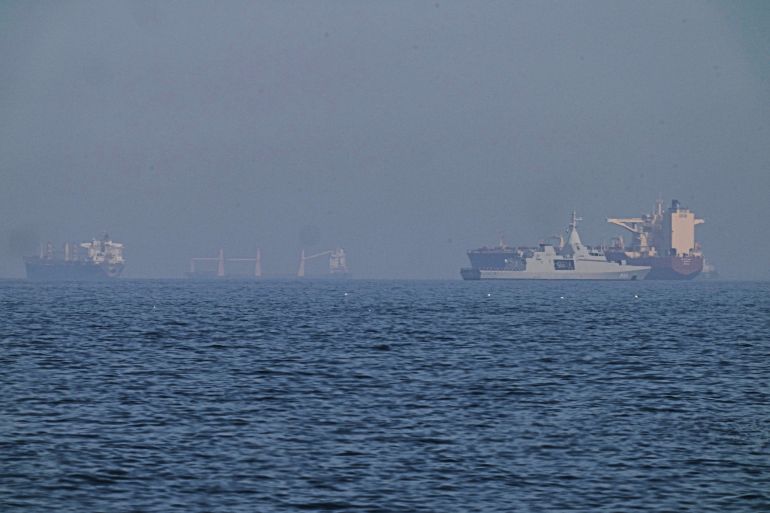
For the US, he noted, the inability to maintain open passage through the Strait of Hormuz served as a stark reminder of the consequences of an unprepared navy. Early in the conflict, Iran imposed restrictions on most vessel traffic through the strait, leading the US to launch its own naval blockade of Iranian ports and ships attempting to transit the waterway on April 13.
“It’s surprising because the United States military has been contemplating this scenario for 45 years,” he remarked, drawing on his own extensive military background. Cancian, a retired US Marine colonel, had a career spanning over three decades, including service in Vietnam, the 1991 Gulf War (Desert Storm), and the Iraq War.
Cancian recalled participating in amphibious planning exercises aimed at capturing Qeshm Island, where Iran is believed to house several of its missiles in an underground facility. “So, this situation didn’t just emerge unexpectedly,” he stated.
However, when the US initiated the current conflict, he observed, “They didn’t have the necessary forces in place.”
“They do now, but they didn’t initially. And then, for whatever reason, it appears they either lack the capability or are unwilling to take the risk to open it,” he concluded.
Ashour also noted that Iran’s military has sustained significant damage. He suggested that the US-Israeli operation has degraded the country’s conventional military infrastructure but failed to eliminate its missiles, munitions, and drones.
He dismissed claims that the Iranian navy was “obliterated” as “far from the truth.”
“One can still engage in naval combat without a conventional or blue-water navy,” he explained. “They were degraded, but they are far from defeated, and far from being out of action.”
#USMilitaryLosses #IranWar #MilitaryEquipment #StrategicStudies #MiddleEastConflict #DefenseNews #Geopolitics #MilitaryAnalysis #USIranTensions #AirDefense


Leave a Reply