

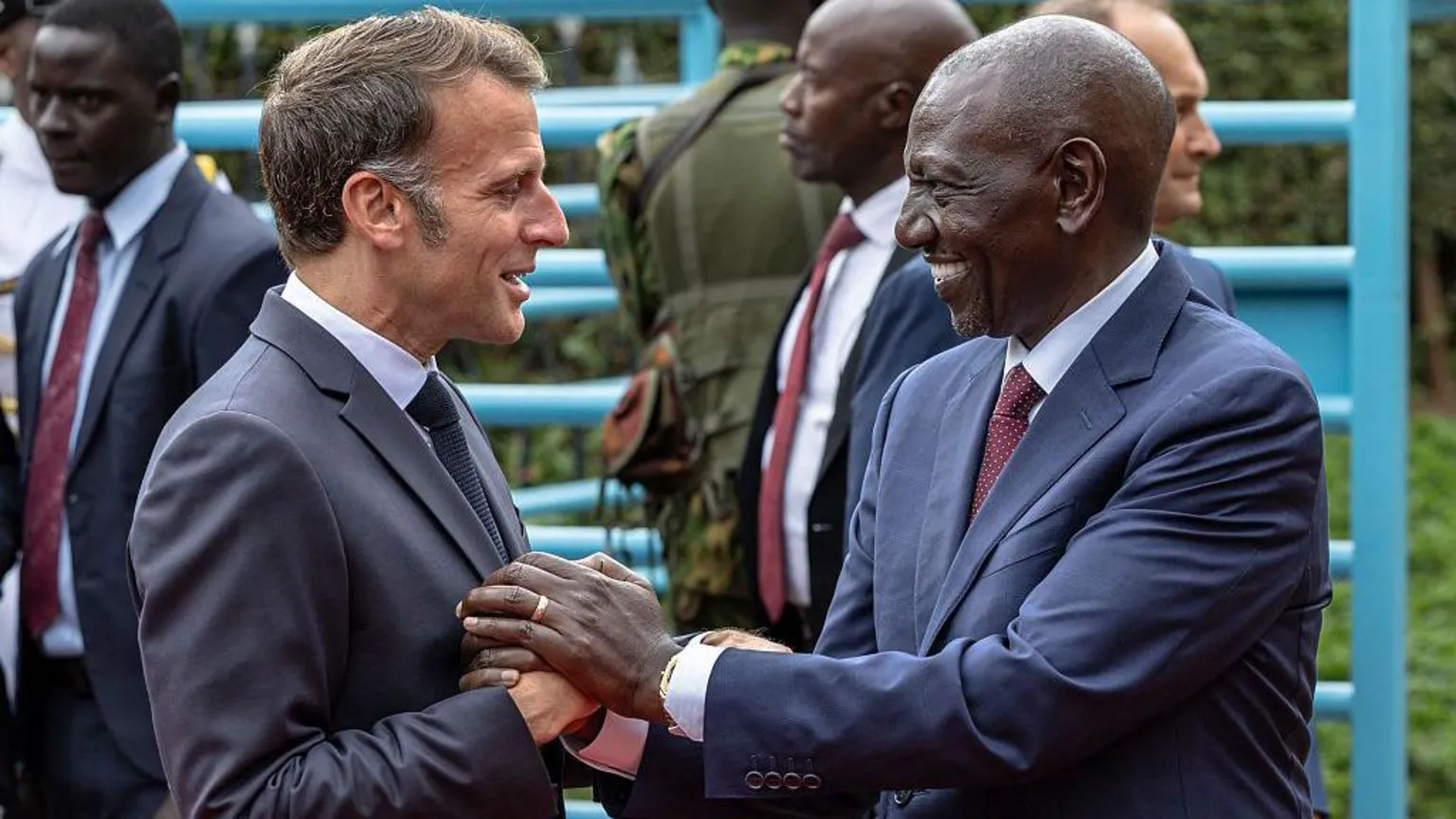
France, frequently criticized for its neo-colonial influence in African nations with historical ties, is actively redefining its engagement. This is exemplified by its unprecedented co-hosting of a summit with African leaders in English-speaking Kenya, marking an effort to expand its partnerships.
Speaking at the Africa Forward Summit in Nairobi, French President Emmanuel Macron underscored the importance of “co-investment” and “equal footing partnerships.” He addressed shared challenges including security, economic dependence, and geopolitical competition. Kenyan President William Ruto, co-hosting the two-day event, affirmed these views, highlighting Africa’s crucial role in shaping the emerging global order rather than remaining marginalized.
Major Investments and Mutual Growth
Macron announced substantial investments totaling $27 billion (£20 billion) in Africa, targeting sectors such as energy transition, digital technology, AI, the maritime economy, and agriculture. He stated these initiatives aim to foster greater self-reliance and create approximately 250,000 jobs across Africa and France. Emphasizing a reciprocal relationship, he urged prominent African business leaders to consider investing in France, not just for France to invest in Africa.
The summit’s primary objective is to broaden Paris’s alliances and secure investment agreements across the continent, against a backdrop of increasing anti-French sentiment and a perceived decline in its influence within former colonies, especially in West Africa. This represents a significant shift in France’s approach to its African relationships.
Shifting Dynamics and Historical Context
For decades following the 1960s independence, France maintained strong economic, political, and security ties with many of its former colonies, often drawing accusations that little had fundamentally changed. Historically, French presidents convened regular summits with African leaders either in France or French-speaking African nations, a tradition now being altered.
Gilles Yabi, a Senegal-based political analyst specializing in France-Africa relations, noted that a “new generation of Africans” desires to move beyond the legacies of colonialism and post-colonial influence. Kenya’s Foreign Minister, Musalia Mudavadi, described the summit as an “opportunity for Africa to start speaking as one.” He highlighted the significance of holding the summit in a non-French-speaking African country, viewing it as a powerful message against basing engagements on official languages and breaking down “artificial” linguistic barriers that hinder integration.
Mudavadi further positioned Kenya as a pivotal country in diplomacy and conventions, explaining that the summit would cover peace and security, with a strong focus on economic partnerships between Africa and the global community, including France. Principal Secretary Korir Sing’oei echoed this, calling Kenya a “bridge-builder” in Africa, noting its unique relationship with France due to its distinct colonial history as a former British colony, unlike many West African nations.
Regional Contrasts and French Presence
In a contrasting development, military leaders who seized power in Burkina Faso, Mali, and Niger—all former French colonies—have expelled French troops previously assisting in the fight against Islamist insurgencies, opting instead for Russian support. Ahead of the summit, Macron defended France’s significantly reduced military presence on the continent, stating that the withdrawal of French troops was “not a humiliation but a logical response to a given situation.” He added, “When our presence was no longer wanted after the coups, we left. I’m convinced that we must let these states and their leaders, even putschists, chart their own course.” Notably, leaders from these three nations were absent from the summit. Djibouti, situated at the mouth of the Red Sea, now hosts France’s sole remaining operational military base in Africa.
Analyst Yabi characterized the summit’s location in Kenya as an “illustration of changing dynamics” in the relationship between African nations and France. He suggested it is not merely a reaction to deteriorating relations with some West African countries but also a long-standing trend, as France recognizes the need to explore new, dynamic markets beyond its traditional former colonies in West and Central Africa.
Africa’s Sovereignty and Global Role
While both Kenya and France anticipate economic benefits from co-hosting the summit, Paris also aims to reassert its relevance on the continent amidst the growing influence of other global powers such as China, Russia, and Turkey. Speaking at the University of Nairobi, Macron emphasized that Africa “needs investment to become more sovereign,” asserting that the continent “no longer… needs or wants to hear” European leaders dictating its needs. He repeatedly stressed that Africa “has its own agenda” and should no longer be viewed solely as a source of raw materials for foreign powers.
Similarly, UN Secretary-General António Guterres stated that African countries should directly benefit from their own resources. He criticized the long-standing practice of Africa’s resources being extracted and value captured elsewhere, advocating for increased local processing, manufacturing, and industrialization. Guterres denounced the current world order as a “global system designed without Africa and still largely operating without Africa,” praising the continent for its leadership in reforming global finance, climate policy, and international governance. He declared, “This is not a continent waiting for solutions; this is a continent producing them.” Guterres also condemned global lending systems, debt burdens, and international credit rating structures that he argued unfairly disadvantage African economies.
The summit involved delegates visiting various Nairobi sites for speeches and events. During one engagement, President Macron interrupted a speaker to request quiet from the audience, stating, “There is a total lack of respect.” While some social media users perceived this as a form of colonial lecturing, contradicting France’s stated shift, others defended his actions as appropriate.
Over 30 African leaders attended the summit, alongside Africa’s wealthiest individual, Nigerian businessman Aliko Dangote, other prominent African industrial leaders, and representatives from major French firms. Arnaud Suquet, France’s ambassador to Kenya, told Kenyan channel NTV that the world is becoming “more brutal and more fragmented, hence why we need more international cooperation.” He also highlighted that France is already Kenya’s fourth-largest source of foreign investment, indicating a long-standing relationship.
Kenya’s Perspective and Future Collaborations
French influence in Kenya is visible through Carrefour supermarkets in affluent Nairobi neighborhoods, offering imported French cheeses, wines, cosmetics, and bakery products alongside local brands. For many younger Kenyans, France is associated as much with retail, fashion, and food as it is with geopolitics, a stark contrast to sentiment in many of France’s former colonies.
Beverly Ochieng, a senior analyst at Control Risks, observed that France is “repositioning and softening its presence and reputation.” She believes France is increasingly utilizing business, investment, and soft power, rather than primarily military influence, to maintain its relevance. France aims to “leverage already recognizable commercial brands, cultural presence and its weight in the European Union to mobilize economic initiatives.”
Meanwhile, Kenya’s government seeks investment in infrastructure, renewable energy, and technology. French companies are already engaged in transport, retail, and energy projects in the country, and officials hope the summit will attract further investment. Early discussions are also underway regarding nuclear energy cooperation as Kenya diversifies its long-term energy strategy. Last month, Nairobi approved a five-year renewable defense agreement with France, encompassing operations such as intelligence sharing, maritime security in the Indian Ocean, and disaster response.
On Tuesday, Guterres reiterated that Africa contributes relatively little to global emissions but disproportionately suffers from climate change impacts, including droughts, floods, and food insecurity. He highlighted the continent’s vast renewable energy potential, particularly solar power, while criticizing the insufficient investment in African clean energy projects. Kenyan Foreign Minister Mudavadi concluded by stating that the two nations were discussing developing and utilizing new areas, emphasizing that the summit’s name, “Africa Forward Summit,” signifies a focus on the future rather than dwelling on the past.
#AfricaForwardSummit #FranceAfricaRelations #KenyaDiplomacy #CoInvestment #EqualFootingPartnerships #AfricanDevelopment #GlobalOrder #EconomicPartnership #PostColonialEra #SustainableInvestment






Leave a Reply