

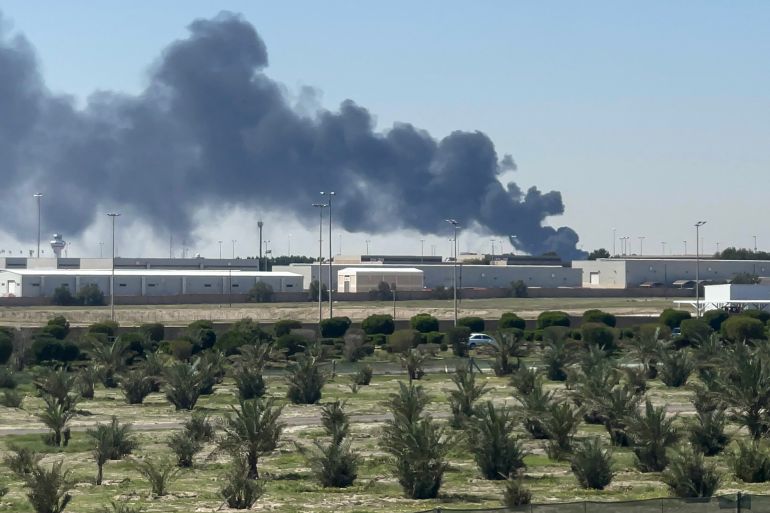
Several Gulf nations have reported missile and drone attacks on their territories, just hours after Iran and the United States announced a two-week ceasefire.
The United Arab Emirates (UAE) stated on Wednesday that its air defenses were “actively engaging” incoming missiles and drones from Iran. The UAE’s Defence Ministry confirmed in a statement that explosions heard across the country were caused by air defense systems intercepting ballistic missiles, cruise missiles, and unmanned aerial vehicles. “The air defenses are currently dealing with missiles and drones coming from Iran,” the ministry added. Operations at Abu Dhabi’s Habshan gas complex were temporarily suspended after a fire broke out early Wednesday due to falling debris, according to the Abu Dhabi Media Office. The interception also resulted in injuries to two Emiratis and one Indian national.
Kuwait also reported that its air defenses were intercepting a wave of Iranian drones launched since 8 am (05:00 GMT), as confirmed by its army. Kuwait’s Defence Ministry stated that its air defense systems responded to “intense hostile Iranian attacks,” dealing with a total of 28 drones. “Kuwaiti armed forces intercepted a large number of drones, some of which targeted vital oil installations and power stations in the south of the country,” it added. Kuwait’s Interior Ministry reported “severe material damage” at several vital facilities belonging to the Kuwait Petroleum Corporation and the energy and water resources ministry following the attack. The ministry noted that fires broke out in some of the attacked sites, including oil facilities and three power stations and water desalination plants.
Bahrain’s Ministry of Interior also reported alleged Iranian attacks, which injured two people, hours after the US announced the ceasefire with Iran. “Two citizens sustained minor injuries and a number of houses were damaged in the Sitra area as a result of shrapnel falling from the interception of an Iranian drone,” the ministry said in a statement. Explosions were heard in Bahrain’s capital, Manama, in the morning, with an AFP journalist reporting smoke rising from an area on Sitra Island, which hosts Bahrain’s principal energy facilities. In an earlier statement, the Interior Ministry said civil defense crews had successfully controlled a fire that broke out in a facility “targeted by the Iranian aggression,” without specifying the location.
The Qatari Ministry of Defence announced that the country was targeted by seven ballistic missiles and a number of drones launched from Iran on Wednesday, adding that all of them were “successfully intercepted.”
Iranian state television confirmed the missile and drone attacks, reporting they were carried out in response to the bombing of Iranian oil facilities on Wednesday. Later, Saudi Arabia’s Defence Ministry announced via a post on X that nine drones had been intercepted and downed “over the past hours.”
Despite the continued attacks after the truce announcement, there is hope in the Gulf region that the ceasefire will hold, according to Al Jazeera’s Malik Traina. Traina, reporting from Kuwait City, suggested that Iran has decentralized its military operations, and the truce violations could be due to “a loose chain” in the communication within the country’s military command. “The hope is that there’s a diplomatic path. That’s what both countries have been calling for the entire time,” he said.
Meanwhile, Iranian state television reported that an oil refinery on the country’s Lavan Island came under attack on Wednesday. The report stated that firefighters were working to contain the blaze, and no one had been hurt. Explosions were also reported on Iran’s Sirri island, according to Mehr news agency.
Washington and Tehran agreed to the ceasefire barely an hour before US President Donald Trump’s deadline to obliterate Iran was set to expire. Gulf countries have faced repeated drone and missile barrages from Iran over recent weeks in response to US and Israeli strikes that began on February 28. Iran targeted fossil fuel infrastructure in the oil-rich Gulf nations while effectively closing the strategic Strait of Hormuz to shipping, through which one-fifth of global oil usually passes.
#GulfAttacks
#IranUSCeasefire
#MiddleEastTensions
#DroneAttacks
#MissileDefense
#RegionalSecurity
#Geopolitics
#EnergyInfrastructure
#DiplomaticPath
#GulfCooperation






Leave a Reply