

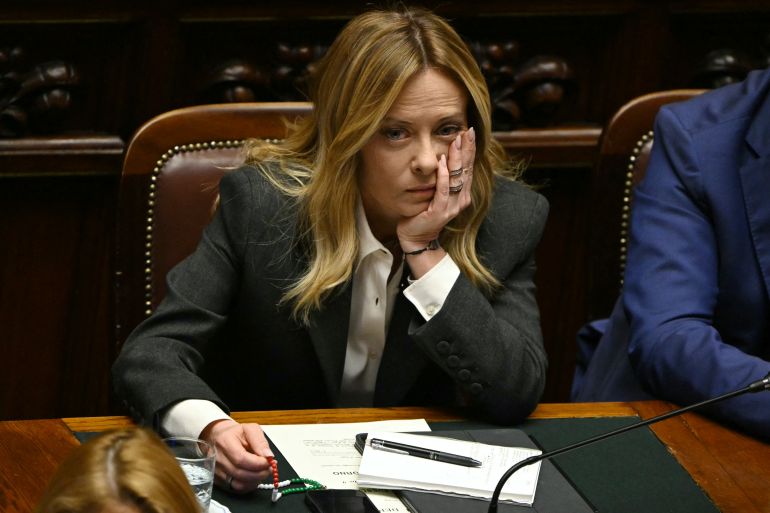
Italy’s decision to suspend a defense agreement with Israel, while possessing “more symbolic value than concrete consequences,” marks an unprecedented move by the Italian government. Analysts suggest it reflects deep unease regarding its longtime ally’s actions in the Middle East.
On Monday, Prime Minister Giorgia Meloni announced that Italy would not renew a memorandum of understanding (MoU) between the two countries’ ministries of defense. Signed in 2003 and ratified in 2005, this accord established a framework for cooperation in areas such as “defense industry and procurement policy” and “import, export and transit of defense and military equipment.”
The MoU was designed for automatic renewal every five years, “unless a written notice of intention to denounce is given” by one country to the other. Such a notice was delivered on Monday in a letter from Italian Defense Minister Guido Crosetto to his Israeli counterpart, Israel Katz.
The Israeli government has largely downplayed the significance of this action. Foreign Minister Gideon Saar stated that it was a deal that “never materialized” and lacked “substantial content,” adding on X, “Israel’s security will not be harmed.” Indeed, the Italy-Israel agreement functioned more as a political framework rather than a series of operational commitments. Moreover, the Italian government’s decision does not outright cancel the pact, as opposition parties and human rights advocates have long called for, but merely suspends it.
Italy’s Policy Shift
Nevertheless, this move represents a significant reversal for a right-wing government that has historically been one of Europe’s staunchest allies of Israel. Alongside Germany, Italy has been a strong opponent of calls to suspend a trade agreement between Israel and the European Union. Italy has largely supported Israel’s actions in Gaza, which a United Nations inquiry states “amounts to genocide,” and has consistently refused to recognize Palestinian statehood.
Recent Strains in Italy-Israel Relations
However, relations between Israel and Italy have recently deteriorated. On Monday, the Italian ambassador to Tel Aviv, Luca Ferrari, was summoned after Italy’s Foreign Minister Antonio Tajani condemned Israel for its “unacceptable attacks against the civilian population” in Lebanon during a visit. Just last week, the Italian government also accused Israeli forces of firing warning shots at a convoy of Italian peacekeepers in southern Lebanon, leading Tajani to summon the Israeli ambassador.
Last week, Israel also conducted a significant attack across Lebanon, reportedly bombing 100 targets in 10 minutes on Wednesday, shortly after a two-week truce between Iran and the US was announced. This series of strikes resulted in hundreds of casualties, marking one of the country’s worst mass killings since the end of its civil war in 1990. Observers suggest that the attack on Lebanon disrupted ongoing efforts to de-escalate regional tensions.
Efforts to De-escalate Middle East Tensions
Michele Valensise, president of the Institute for International Affairs and former secretary-general of Italy’s Ministry of Foreign Affairs, stated that the Italian government’s decision to suspend its defense agreement with Israel “must be seen within a broader effort to progressively stabilize the region, including by reducing tensions in Lebanon.”
Valensise added, “Israel’s military operation there objectively constitutes an irritant, complicating negotiations with the Iranians. If the Lebanese front can be part of a deal with Iran, then everyone has an interest in de-escalation there.” He further emphasized, “Italy remains a friend to Israel, but this relationship does not preclude it from taking a critical position against certain choices of the Israeli government.”
European governments, including Italy, have been observing with concern as the United States-Israeli conflict involving Iran has developed. Following initial joint Israel-US strikes on Tehran on February 28, Iranian forces brought shipping traffic in the Strait of Hormuz to a near-total halt. This action caused the paralysis of one-fifth of global oil and liquefied natural gas (LNG) exports that typically pass through the narrow waterway in peacetime.
After a first round of high-stakes Iran-US talks in Islamabad last weekend failed, amidst a fragile two-week truce, Washington imposed a naval blockade on Iranian ports. This development has further aggravated fears of a protracted energy crisis, a significant concern for Italy, which heavily relies on gas imports.
Economic and Political Pressures
Perhaps more significantly, Italy’s government and Prime Minister are preparing for elections next year. Arturo Varvelli, a political scientist and senior policy fellow at the European Council on Foreign Relations, noted, “There is a general discontent over the conflict in Iran and the crisis in the Strait of Hormuz – a crisis that is impacting Italian growth and, if it continues, could have a significant impact on citizens, something Meloni worries about in a pre-election year.”
Italian public opinion also exhibits a “strong pro-Palestinian component.” Last October, over two million Italians participated in a general strike in solidarity with the Global Sumud Flotilla, which was intercepted by Israel while attempting to deliver aid to Palestinians in Gaza. The flotilla, carrying 40 Italian passengers, had called on Israel to “stop the genocide.”
Varvelli expressed concern, stating, “There’s a concern that this will be a long agony, between an increasingly unmanageable Trump and the economic problems he and Netanyahu have caused with the conflict in the Middle East.”
After years of striving to be seen as US President Donald Trump’s “whisperer” in Europe, Meloni has been prompted by the conflict in Iran to create some distance between herself and Trump. Rome declined the US president’s request to join a naval coalition aimed at opening the Strait of Hormuz and to permit US bombers to refuel at a military base in southern Italy.
Trump’s Criticism of Meloni
Trump had remained silent on these decisions until yesterday, when, in an interview with the Italian newspaper Corriere della Sera, he criticized Meloni. The Italian Prime Minister had previously defended Pope Leo XIV after he became involved in a dispute with Trump. Pope Leo had condemned the US president’s threat that Iran’s “civilization will die” if it did not reopen the Strait of Hormuz. In response, Trump launched a barrage of criticism at Leo, calling him “weak on crime” and “terrible for foreign policy,” stating he does not “want a Pope who criticizes the President of the United States.”
Trump also posted an unusual image of himself on social media, depicting him as a Christ-like figure healing the sick. Following widespread criticism, he later claimed it was intended to portray him as a doctor. Regarding Meloni, whom he once affectionately referred to as “a real live wire,” Trump stated, “I’m shocked at her” during an interview with Corriere della Sera on Tuesday. He further remarked in the interview, “Do people like her? I can’t believe it,” and added, “I thought she had courage. I was wrong.”
#ItalyIsraelRelations #GiorgiaMeloni #DefensePact #MiddleEastTensions #ItalianPolitics #InternationalRelations #StraitOfHormuz #EnergyCrisis #EuropeanPolitics #GazaConflict



Leave a Reply