

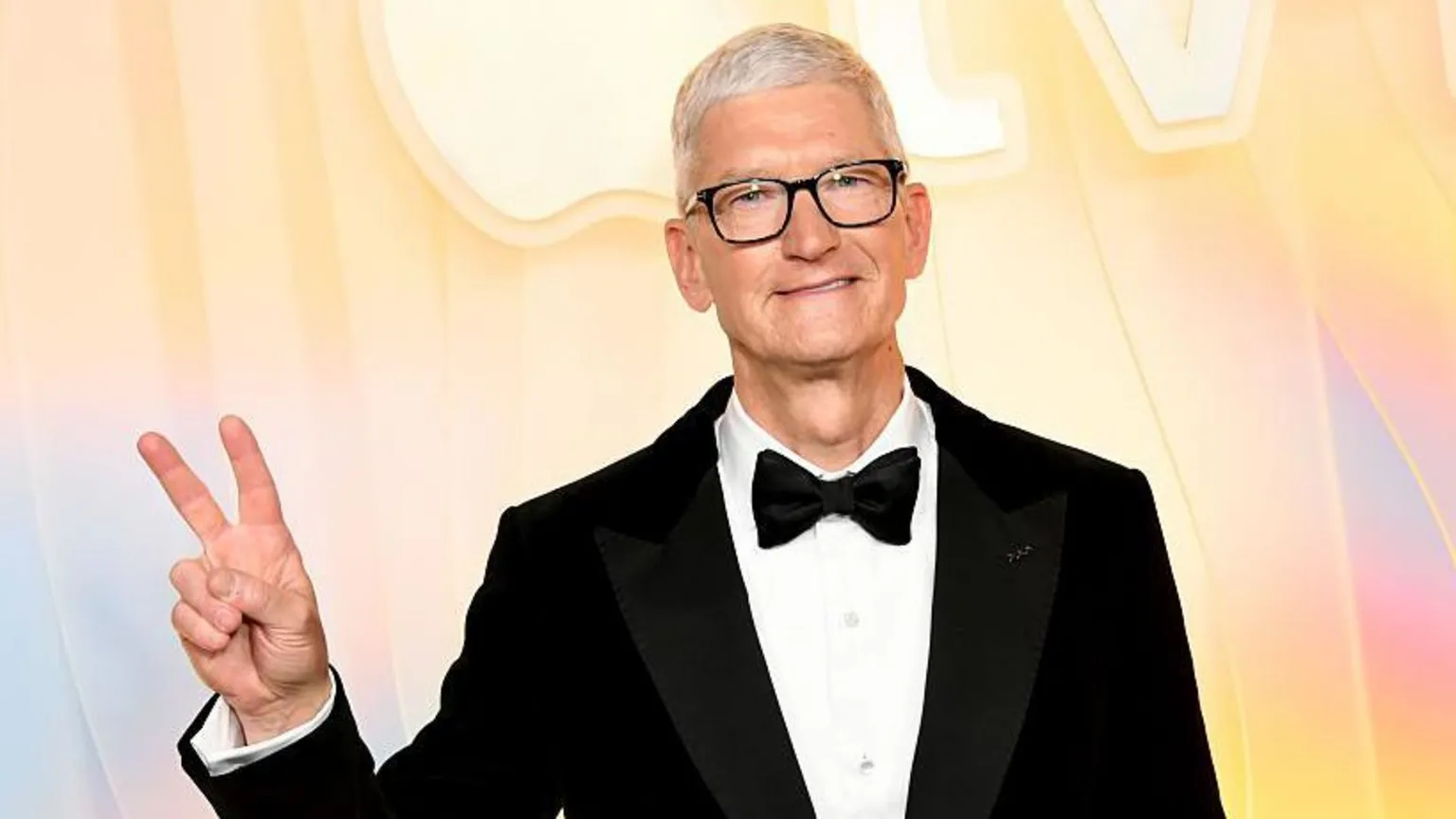
Apple has named John Ternus as its new chief executive, replacing Tim Cook, who is stepping down after 15 years at the helm of the technology giant. Ternus, the current head of hardware engineering and a 25-year veteran at Apple, will assume the role on September 1st, with Cook transitioning to executive chairman.
Cook has served as Apple’s chief executive since 2011, taking over after co-founder Steve Jobs resigned due to health reasons shortly before his passing.
Cook will remain CEO through the summer to facilitate a smooth transition with Ternus, after which he will “assist with certain aspects of the company, including engaging with policymakers around the world.”
Cook’s decision to step down from the chief executive role follows months of speculation regarding a successor for Apple, which recently celebrated its 50th anniversary.
He described the position as “the greatest privilege of my life.” During his tenure, he guided the company to become one of the most valuable in the world.
In 2018, Apple made history as the first public company to reach a $1 trillion valuation. It is now valued at $4 trillion.
Cook lauded Ternus as a “visionary” executive possessing “the mind of an engineer, the soul of an innovator, and the heart to lead with integrity and honor.”
“He is, without question, the right person to lead Apple into the future,” Cook affirmed.
Ternus had emerged as a frontrunner to succeed Cook last year, following the departure of another long-serving executive, Chief Operating Officer Jeff Williams.
Throughout his quarter-century at Apple, Ternus has been instrumental in nearly every major product release, including every generation of the iPad, numerous iPhone iterations, and the launch of AirPods and the Apple Watch.
He also oversaw the significant transition of Mac computer processors from Intel to Apple’s proprietary silicon.
In a statement on Monday, Ternus referred to Cook as his “mentor.”
“I am filled with optimism about what we can achieve in the years to come,” Ternus stated.
Focus on ‘Differentiation’
Naming a leader with a strong product and hardware background may help Apple address persistent criticism of Cook’s tenure regarding a perceived lack of innovation.
While Cook oversaw a four-fold increase in Apple’s yearly profit and a massive global expansion of product sales, its core product line has remained largely static.
Dipanjan Chatterjee, a principal analyst at Forrester, lauded the financial stability Cook brought to Apple but noted that he hadn’t delivered a groundbreaking product like the iPhone, which could secure another two decades of success for Ternus.
He stated that Apple “remains structurally dependent on the phone” as it “searches for its next growth engine.”
Chatterjee suggested that Ternus’s appointment indicates Apple is seeking “differentiation” in its products, adding that the new leader “must resist the temptation of incrementalism that has plagued Apple of late and escape the iPhone’s gravitational pull.”
Ken Segall, Steve Jobs’ creative director for over a decade, told the BBC: “I don’t think Tim ever really shook the operations guy vibe. I think when people talk about the difference between Steve and Tim, that was basically it – Steve the visionary, Tim the operations guy who took over.”
Gil Luria, managing director at DA Davidson & Co, commented that having a hardware-focused leader now suggests Apple will dedicate more energy to new products, such as foldable phones and wearable devices like smart glasses.
The tech giant has also faced criticism for its slow adoption of the surging demand for AI, ultimately integrating technology from Google and OpenAI into its operating systems.
Following Monday’s announcement, OpenAI’s Sam Altman posted on X: “Tim Cook is a legend. I am very thankful for everything he has done and I am very thankful for Apple.”
Cook did not originate from a hardware or product development background when he joined Apple. Instead, he spent many years as a business operator at companies like IBM and Compaq, focusing on operations, fulfillment, logistics, and sales figures rather than conceptualizing and launching new technological products.
That was precisely what Jobs was best known and lauded for.
One of the most significant product launches during Cook’s leadership was the Apple Vision Pro, a virtual and augmented reality headset that has yet to gain widespread adoption among consumers.
Nevertheless, his exceptional skill as an operational executive will ensure he is widely remembered as one of the most successful business leaders.
Timothy Hubbard, a professor at the University of Notre Dame Mendoza College of Business, stated that Cook’s era transformed Apple into a company “the best at refining, scaling, and defending an extraordinarily powerful system.”
“The real question now is whether that same organization can pivot toward exploration, where success depends on speed, uncertainty, and a greater willingness to experiment,” he added.
Apple’s apparent reluctance to fully embrace AI products and services has distinguished it from competitors like Google, Microsoft, and Meta, which are investing hundreds of billions annually to advance in this domain.
Hubbard suggested that with a new leader, Apple might be signaling a strategic interest in deeper integration of AI into its hardware.
“The very strengths that made Apple dominant – their discipline, polish, and control – could become constraints if the next era rewards openness and faster iteration,” he cautioned.
“That rapid innovation is where Apple started, and perhaps that’s where the company needs to return.”
#AppleLeadership #JohnTernus #TimCook #AppleCEO #TechNews #Innovation #HardwareEngineering #AppleFuture #SiliconValley #AIinTech








Leave a Reply