

Sydney, Australia – Rosco Jewell, who operates the online marketplace Amazing EV, previously sold approximately one used electric vehicle every two months. However, in recent weeks, coinciding with escalating tensions in the Middle East, Jewell’s sales have surged, with a second-hand EV now being sold roughly every two weeks.
“It is now becoming very challenging to source used EVs in the $20,000 to $50,000 price bracket. We’ve also observed a significant price increase of 10 to 15 percent, and in some instances, up to 20 percent,” the Sydney-based businessman informed Al Jazeera.
Global EV Demand Surges Amidst Rising Fuel Costs
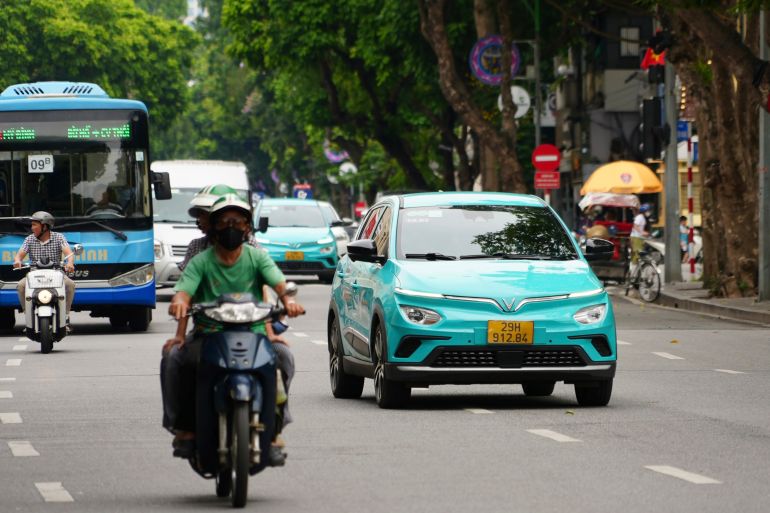
As the ongoing conflict in the Middle East continues to push up global petrol and diesel prices, the demand for electric vehicles (EVs) has seen a remarkable surge across many nations. Both the United States and China, the world’s two largest economies, have experienced a significant uptick in EV sales, recovering from market downturns. Chinese manufacturers, for instance, reported an impressive 82.6 percent month-on-month sales increase in March, as per the China Automotive Dealers Association. In the US, EV sales exceeded 82,000 units last month, marking a more than 20 percent rise from February, despite a year-over-year decrease. Meanwhile, in Vietnam, the domestic EV brand Vinfast announced a substantial 127 percent year-on-year sales growth in March.
Euan Graham, an analyst from the energy think tank Ember, noted that the recent geopolitical events have intensified the trend of EV adoption in emerging markets, particularly in Southeast Asia. This acceleration is reminiscent of previous energy crises, such as the one following the conflict in Ukraine. Graham explained to Al Jazeera, “We are currently witnessing a period in the 2020s marked by two consecutive fossil fuel shocks.” He elaborated that historical patterns suggest nations seek alternative solutions during such times, and in the current decade, electric vehicles represent an increasingly competitive and viable option. “I anticipate this will lead to a permanent shift in the rate of EV adoption across several countries,” he concluded.
Global Snapshot: EV Sales Soar Across Continents
Across Asia, Japan’s EV sales nearly tripled year-on-year last month, and South Korea experienced a remarkable 172 percent surge in domestic EV purchases. European nations also reported significant growth; France saw a three-fold increase in new Tesla registrations, with Norway, Sweden, and Denmark observing similar spikes for the EV brand. In Australia, battery electric vehicles constituted 14.6 percent of total vehicle sales in March, almost double the figure from the same month in 2025, as reported by the Federal Chamber of Automotive Industries. David Smitherman, CEO of Sydney-based BYD distributor EVDirect, confirmed a sharp rise in inquiries, anticipating these to convert into substantial sales in the near future.
Smitherman, whose company oversees 90 showrooms for the Chinese carmaker, noted to Al Jazeera, “We’ve observed a significant influx of customers visiting our stores, clearly driven by concerns over fuel prices and a desire to better manage their transportation costs.” In Melbourne, Kevin Alberica, operations and sourcing manager at Evolve Motors, an EV dealership, recounted a remarkable instance where a staff member sold seven Teslas in a single Saturday. “I’ve never witnessed multiple people queuing for a single car before,” Alberica shared with Al Jazeera. He added, “We once had over 100 Teslas in stock, but now our inventory is almost depleted. Replenishing it is proving challenging.” This surge is particularly impactful in Australia, a major exporter of coal and LNG, yet a nation that imports approximately 80 percent of its petrol and diesel requirements.
Last month, the Australian government announced that the country held roughly one month’s worth of fuel reserves, with shipments secured until May. “This news is undoubtedly alarming the public,” Alberica stated, observing that “many business owners, perhaps those with diesel vans, are now coming in to purchase a Tesla Model.”
Charles Lester, data manager at Benchmark Mineral Intelligence, highlighted that the future trajectory of global EV demand is intrinsically linked to petrol prices. He explained to Al Jazeera, “If fuel prices remain elevated for an extended period, consumers, when making vehicle purchasing decisions, will increasingly consider electric vehicles as a viable option.”
Government Initiatives and Consumer Benefits
The surge in EV demand has fueled optimism among advocates, who hope governments will adopt a more proactive stance in supporting the transition away from internal combustion engines. In New South Wales, Australia’s most populous state, the government recently announced a $71 million initiative to fund EV charger installations in regional areas. However, these positive steps are somewhat offset by a federal review of Australia’s substantial EV tax breaks, with Treasurer Jim Chalmers expected to reduce the fringe benefits tax exemption in the upcoming May budget. James Pickering, national president of the Australian Electric Vehicle Association, told Al Jazeera that Australia is “uniquely well positioned” to capitalize on transportation electrification, thanks to its decades of success in both large-scale and consumer renewable energy. For many Australian consumers, switching to an EV has proven to be a significant advantage, especially after years of elevated inflation post-COVID-19. Jarred, a 27-year-old public servant in Melbourne, purchased his first EV in February, just prior to the recent escalation of Middle East tensions. “The running costs have been incredibly impressive,” Jarred, who preferred to be identified by his first name, shared with Al Jazeera. He added, “I can achieve a full charge at home for merely $6.60 with my new electricity rates. I truly have no complaints so far.”
#EVs #ElectricVehicles #MiddleEastConflict #FuelPrices #SustainableTransport #GreenEnergy #AutomotiveIndustry #EVAdoption #ClimateAction #AustraliaEV








Leave a Reply