

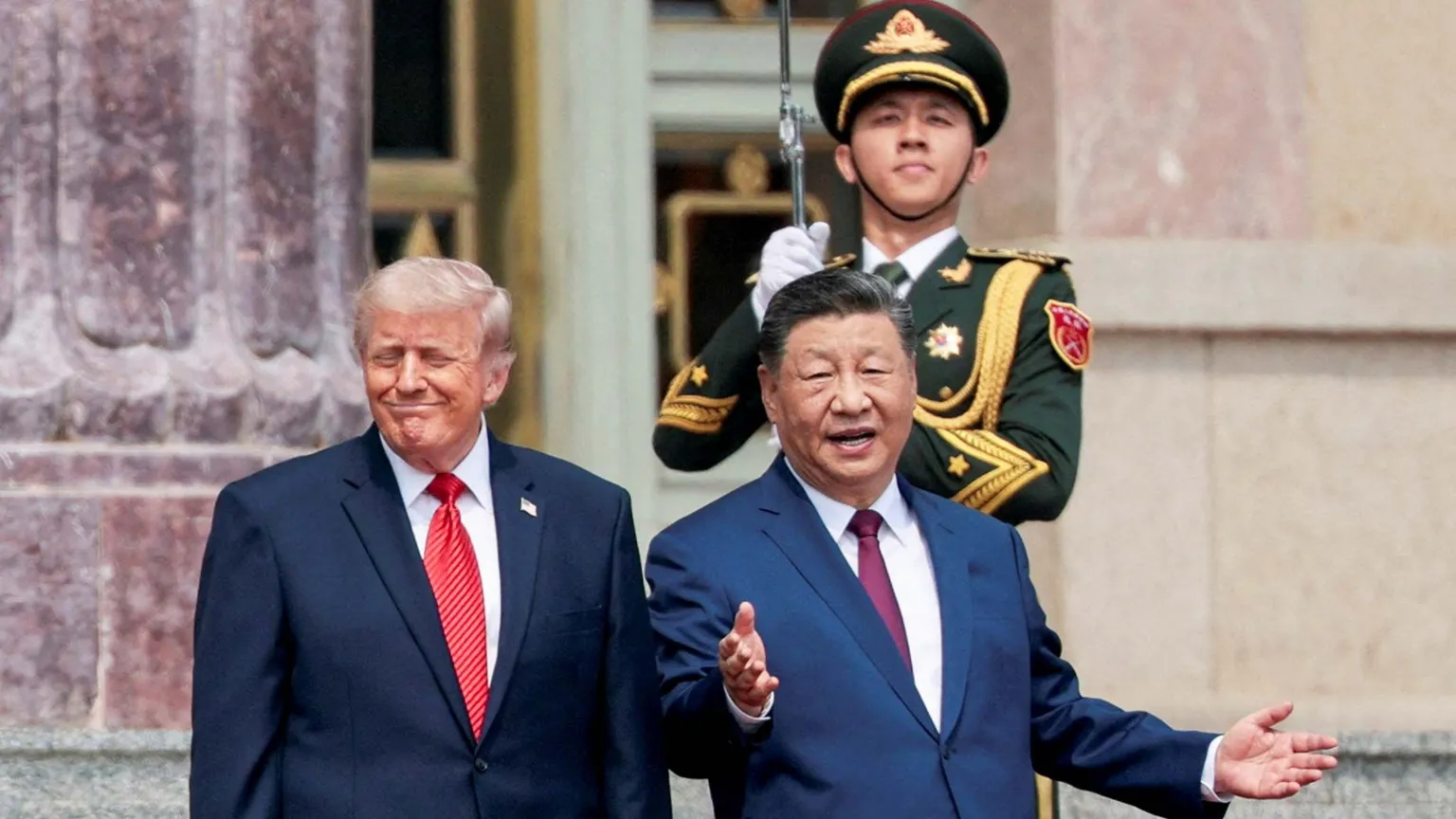
Xi Jinping threw a grand welcome for Donald Trump on the first day of a visit that could reset ties between the rival superpowers.
The military honour guard lined up outside the Great Hall of the People to welcome Trump, complete with a gun salute and a band playing the US national anthem. The president paused twice to say hello to schoolchildren cheering with Chinese and American flags.
As he shook hands with Xi, he leaned in to pat him on the arm in what appeared to be a gesture of warmth. And he lavished praise on his host.
“You’re a great leader. I say it to everybody,” he declared in what appeared to be unscripted remarks. Later, on his tour of the 15th Century Temple of Heaven, he remarked to reporters that China was beautiful. At the banquet this evening, he called the talks a “cherished opportunity.”
It was a remarkable day given Trump built up his political brand by talking tough on China.
“We can’t continue to allow China to rape our country, and that’s what they’re doing,” he told a campaign rally in 2016.
In 2020, he claimed China has “ripped off the United States like no one has ever done before”, and described the Covid-19 pandemic as the “Chinese virus”. Before returning to power, he vowed to “make China pay.”
Thorny Issues Remain
At the height of the trade war last year, the two sides had levied tariffs that crossed 100% on each other. A fragile truce followed but one of the main questions hanging over this visit is whether that will last, and what deal would take its place?
The others are around Iran – can Beijing help broker a deal? – and Taiwan, the US ally and self-governed island that China claims as its territory.
Beijing put on a spectacle designed to flatter Trump ahead of any deal to prove China’s door is open to guests. However, soon after talks began, state media published comments from Xi making clear that tensions over Taiwan could prove challenging.
But the meticulous choreography was not just for the benefit of Trump and the 30 CEOs who accompanied him. It was also a show of strength, which Beijing knows will be beamed live across the US and the world.
“We are witnessing a historical change,” says John Delury, a senior fellow from the Centre on US-China Relations at the Asia Society.
“I hesitate to put too much on this specific summit, but the inexorable rise of China to a place where it is legitimately rivalling the U.S. – that is now happening before our eyes. Beijing is now the second world capital.”
A Show for Everyone
President Xi has been eager to portray himself as a stable global leader in contrast to a mercurial US president. Given the size of China’s economy, a number of world leaders, including those from US allies such as Canada, the UK and Germany, have turned up, eager to do a deal with Beijing.
China’s trade with the rest of the world has expanded since Trump’s first term as it braced for exactly what he warned of: more tariffs.
Last year, it flexed its economic and diplomatic muscle, responding to Trump with tit-for-tat tariffs and restricting the export of rare earth minerals essential for advanced manufacturing. Washington came to the table and tariffs were lowered.
Xi will believe he has shown the US and the world just how dependent they are on Chinese manufacturing and technology. China now makes a third of the world’s goods, processes more than 90% of its rare earth minerals and produces around 60 to 80% of all solar panels, wind turbines and electric vehicles.
While concerns about its record on human rights, and its relationships with regimes like Moscow and Pyongyang persist, they seem to have been overshadowed as Trump shakes up the world order.
Some would see this as a sign that the balance of power is shifting in China’s direction.
Iran as a Bargaining Chip
China will surely feel it has the upper hand in these talks as Xi faces a Trump weakened by the war on Iran. The blocked Strait of Hormuz has rattled the global economy and Trump is expected to seek Beijing’s help to open up the shipping corridor.
Beijing and Tehran have a relationship dating back decades and China is Iran’s biggest trading partner. If Xi helps nudge Tehran towards the negotiating table, it may give him even more leverage.
“It’s in their interest to resolve this,” US Secretary of State Marco Rubio told Fox News before the trip. “And we hope to convince them to play a more active role.”
But China will want something in return.
Xi has already warned Trump during their talks that the issue of Taiwan could bring the two countries into conflict, according to Chinese state media.
He could pressure the US to delay or stop arms sales to Taiwan, although Washington is legally bound to provide the island with the means to defend itself. Still, officials in Taipei will be watching this summit nervously.
When reporters asked the two leaders at the Temple of Heaven if they had discussed Taiwan, neither responded to the question.
Unlike the last time, when Melania Trump accompanied her husband, this is a very different visit. It appears the focus is on the business delegation, which included Elon Musk, Tim Cook and chipmaker Nvidia’s boss Jensen Huang. They were all present at the banquet as well.
Trump will want this delegation to take centre-stage as he calls for China to open its doors to more US firms.
What all this amounts in terms of a deal is still unclear because no details have been released. The White House statement only said that the two sides “discussed ways to enhance economic cooperation“, including expanding US firms’ access to the Chinese market and Chinese investment in US industries.
On Iran, it added that “both countries agreed that Iran can never have a nuclear weapon” and “the Strait of Hormuz must remain open to support the free flow of energy.”
What Comes Next?
Friday, when the two leaders will meet again, could yield more details.
Trump will want a win to sell back home as his approval ratings continue to fall.
Xi has said that the two sides should expand exchanges and co-operation in areas such as trade and agriculture – a signal perhaps that China is ready to buy more American soybeans, beef and Boeing aircraft.
The two leaders have also agreed to frame their relationship as “constructive, strategic and stable” in a new positioning that will guide ties for the next three years.
China is grappling with serious economic challenges from rising unemployment, uneven growth, a real estate crisis and sky-high levels of local government debt.
So Beijing may not want a world with Washington at the centre of global power, but it needs to find a way to get along with the US.
And that was the message both leaders seemed to be sending tonight at the banquet.
Basking in the “magnificent welcome like no other” that he had received, Trump invited Xi to the White House in September.
Xi went further, saying “the great rejuvenation of the Chinese nation” and “Make America great again” can go hand in hand.
He ended his speech with a toast to the future of both America and China: “Cheers.”
Understanding Tariffs
Companies that bring foreign goods into the US have to pay the tax to the government.
Tariffs are a central part of Trump’s economic vision. He argues they grow the US economy, protect jobs and raise tax revenue, but critics say they hurt the global economy and push up prices.
He also uses them as a bargaining chip to put pressure on trade partners and to punish countries that he believes have acted against US interests.
In 2018, Trump announced successive rounds of tariffs on Chinese imports. Beijing responded with its own tariffs on Washington.
US tariffs on Chinese goods hovered around the 20% mark in Trump’s first term, and throughout Joe Biden’s presidency.
Beijing, at the time, was heavily reliant on trade with America as lots of goods produced in China were sold in the US.
On Trump’s so-called Liberation Day in April 2025, he set a 34% levy on Chinese goods, making the total tariffs on China the highest of any country.
Beijing hit back by introducing duties on US agricultural goods coming to China, squeezing American farmers.
China also made plans to tighten its rules for exports of rare earths, a crucial material for making cars, smartphones and many other items.
Unlike in 2018, the Chinese economy proved more resilient to Trump’s tariffs, partly due to its near monopoly on key materials and advances in the manufacturing of renewables and electric cars.
In February 2026, the US Supreme Court ruled that the majority of tariffs Trump introduced in 2025 were illegal. This included the tariffs on China over allegations of fentanyl smuggling and so-called Liberation Day tariffs.
Trump and Xi Jinping met in October 2025, leading to a cooling of trade tensions between the two powers.
Beijing suspended export controls placed on rare earths and agreed to start buying US agricultural goods.
#USChinaRelations #DonaldTrump #XiJinping #TradeWar #Geopolitics #Diplomacy #Taiwan #IranDeal #GlobalEconomy #Summit



Leave a Reply