

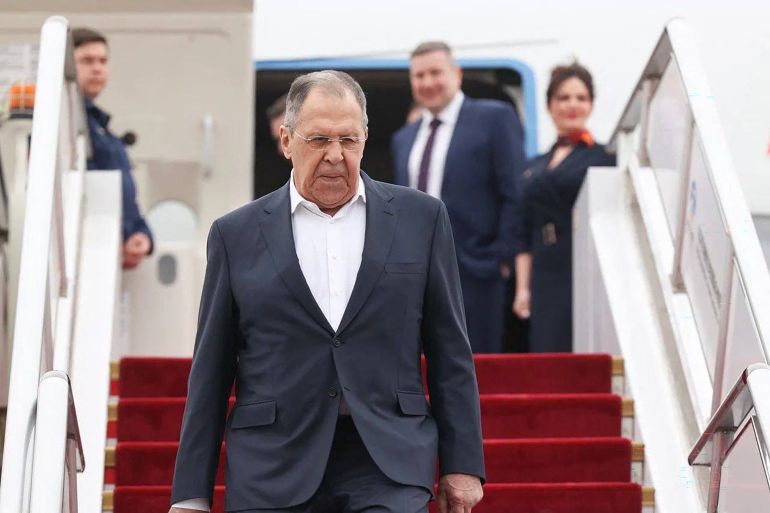
Russian Foreign Minister Sergey Lavrov has arrived in Beijing at a critical time, as the United States implements a blockade of the Strait of Hormuz, a vital waterway through which China receives approximately one-third of its oil imports. Lavrov was accorded a red-carpet welcome on Tuesday, as evidenced by photographs released by Russia’s Ministry of Foreign Affairs.
Both Beijing and Moscow have publicly condemned the United States and Israel for their military actions against Iran. China, in particular, has felt the economic repercussions of the resulting energy crisis. As a significant importer of Iranian oil, China has also sharply criticized a recent US initiative to blockade vessels entering or departing Iranian ports and coastal regions, encompassing areas within the Gulf and the Gulf of Oman.
“The Strait of Hormuz represents a crucial international trade route for both goods and energy,” stated Chinese Ministry of Foreign Affairs spokesman Guo Jiakun on Monday. “Ensuring its security, stability, and unimpeded flow serves the common interests of the global community.”
Alan Fisher of Al Jazeera, reporting from Washington, DC, highlighted that the US objective is to economically cripple Iran by obstructing all maritime traffic to and from its ports. “The US anticipates that this will generate pressure on Iran from its key business partners, including China,” Fisher explained, noting that Beijing sources approximately one-third of its oil from Iran. “The United States hopes that this pressure on China will, in turn, compel China to exert influence on Iran, urging it back to the negotiating table.”
On Monday, Lavrov engaged in a telephone conversation with his Iranian counterpart, Abbas Araghchi. According to a statement from the Russian Foreign Ministry, the senior Russian diplomat underscored the importance of preventing any resurgence of hostilities in the Middle East and affirmed Russia’s readiness to facilitate a peaceful resolution. “Sergey Lavrov emphasized the critical need to avert a recurrence of armed confrontation and reiterated Russia’s steadfast commitment to assisting in the resolution of this crisis, which, he stressed, has no military solution,” the ministry’s statement read. The ministry further noted that Araghchi informed Lavrov about the details of the US-Iran talks held in Pakistan over the weekend, which ultimately failed to achieve a breakthrough.
Beijing and Moscow maintain robust economic and political ties, a relationship that has significantly strengthened since Russia’s full-scale invasion of Ukraine in 2022. Earlier, on April 5, Chinese Foreign Minister Wang Yi also held a call with Lavrov, during which they concurred on the importance of Beijing and Moscow collaborating to de-escalate Middle East tensions.
Beijing has been a hub of diplomatic activity this week, hosting leaders from nations impacted by the conflict and its economic repercussions. Among them were Spanish Prime Minister Pedro Sanchez and United Arab Emirates President Mohamed bin Zayed Al Nahyan (MBZ). Chinese President Xi Jinping met with both MBZ and Sanchez on Tuesday morning, while Vietnamese President To Lam is anticipated to arrive in China for a four-day visit.
“Many observers globally have expressed surprise that China has not assumed a more proactive role in the Iran conflict, especially given its strong ties with Tehran, including its position as Iran’s largest trading partner and crude oil purchaser,” noted Al Jazeera’s Katrina Yu, reporting from Beijing. Yu elaborated, “However, beyond advocating for restraint and further negotiations, China appears to be leveraging this period to engage with nations that may be growing disillusioned with the US or seeking to reduce their dependence on Washington.” “China is positioning itself as an alternative to Washington – a reliable, stable, and predictable partner. This message resonates strongly with many states,” Yu concluded.
Former US President Donald Trump, who is slated to visit Beijing next month for discussions with President Xi, declared on Sunday that he would impose a 50 percent tariff on Chinese goods if Beijing provided military assistance to Tehran. These remarks followed a CNN report on the same day, which, citing three sources familiar with intelligence assessments, stated that US intelligence suggested China was preparing to supply new air defense systems to Iran within weeks. On Tuesday, Chinese Foreign Ministry spokesman Guo dismissed these reports as “completely fabricated.” He warned, “Should the US insist on using this as a pretext to impose additional tariffs on China, Beijing will undoubtedly implement resolute countermeasures.”
#RussiaChinaRelations #USIranTensions #StraitOfHormuz #MiddleEastDiplomacy #GlobalOilMarket #ChinaForeignPolicy #IranSanctions #InternationalRelations #Geopolitics #EnergySecurity






Leave a Reply