

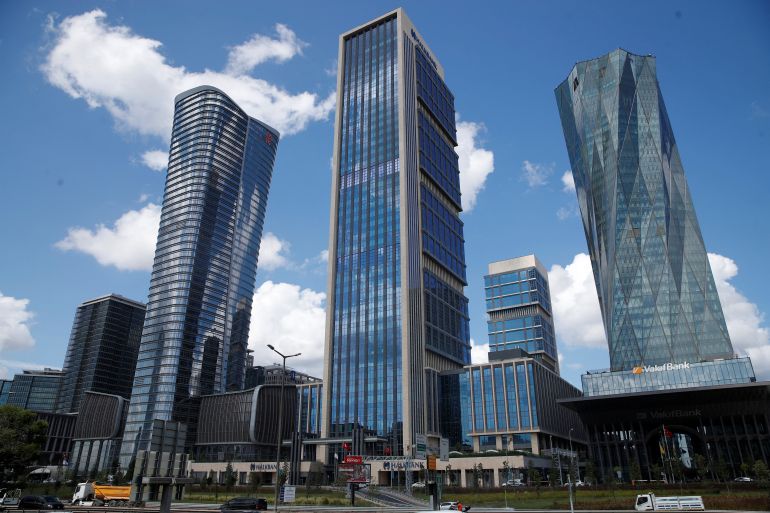
For the Turkish government, the ongoing regional conflict has added complexity to its efforts to revitalize an economy still recovering from one of the most severe financial crises in the nation’s history. While the conflict has led to increased fuel prices in Turkiye and compelled authorities to utilize valuable foreign currency reserves to support the lira, it has also paradoxically opened up new avenues for the country. With the repercussions of the conflict spreading throughout the Middle East, Ankara has seized the opportunity to position Turkiye as a beacon of security and stability for international businesses and investors. Notably, while infrastructure in the United Arab Emirates, Saudi Arabia, and Qatar has reportedly sustained significant damage from missile and drone attacks – incidents often attributed to Tehran – Turkiye, bolstered by NATO air defenses, has largely remained unaffected by these aerial assaults.
‘New Doors’ for Investment
Turkish officials have openly expressed their intent to capitalize on the uncertainty the conflict has created for prominent regional business centers like Dubai, Doha, and Riyadh. This conflict, currently under a two-week ceasefire between the United States and Iran, has cast a shadow over these hubs. Earlier this month, Turkish President Recep Tayyip Erdogan, who recently engaged with 40 global CEOs to discuss enhancing his nation’s competitiveness, framed the ongoing situation as an advantage for Ankara’s aspirations to elevate Istanbul into a premier global financial center. In a statement shared on social media, Erdogan remarked, “Just as during the pandemic, we wholeheartedly believe that this global crisis will also open new doors for our country.”
Following this, Turkish Treasury and Finance Minister Mehmet Simsek confirmed that the government is indeed preparing “radical” incentives designed to attract foreign capital. Bilal Bagis, head of the economics department at Fatih Sultan Mehmet Vakıf University in Istanbul, noted that Turkiye’s enhanced economic stability since its 2018 debt crisis, coupled with various financial incentives, has helped reposition the country as a regional hub and a “safe haven.” Bagis told Al Jazeera, “A liberal investment environment, ease of entry, and new comprehensive incentive packages should significantly boost its position.”
Although Ankara has not yet officially confirmed the specifics of these upcoming measures, Guney Yildiz, a Turkish-born adviser at Anthesis Group with clients in the Gulf, suggests they are likely to include tax breaks for companies that facilitate goods sales through Turkish entities without physically importing them into the country. “This means a commodities trader or a logistics company could book transactions through Istanbul and receive a substantial tax benefit,” Yildiz explained to Al Jazeera. He added that this strategy is a direct challenge to the intermediation business model that Dubai has dominated for two decades, emphasizing that “the timing is obviously shaped by the war.”
Turkiye’s Ministry of Treasury and Finance did not comment on the specific measures under consideration. However, these plans align with a series of recent initiatives designed to attract foreign investment, notably the inauguration of the Istanbul Financial Center (IFC) in 2023. This special economic zone provides significant tax incentives to financial institutions, including a 100 percent exemption from corporate tax on export earnings until 2031. An IFC spokesperson reported that the district has recently experienced “growing and concrete” engagement from both foreign governments and private institutions. “There is a particularly strong strategic focus from Far Eastern institutions,” the spokesperson informed Al Jazeera. The spokesperson further elaborated, “This engagement is not limited to private sector companies; we are also seeing interest at the government level. We maintain close contact with Japan and South Korea, and our discussions with the United Kingdom are ongoing.” They highlighted Istanbul’s “powerful triple advantage built on geography, innovation, and economic depth.” “From Istanbul, institutions can access approximately 1.3 billion people and a $30 trillion economy within a four-hour flight,” the spokesperson stated.
Challenges and Competition
Despite these efforts, Istanbul faces a significant uphill battle to genuinely compete with established financial hubs like Dubai. The latest Global Financial Centres Index, compiled by Z/Yen Partners in collaboration with the China Development Institute, places Istanbul at 101st. This is considerably behind Dubai (7th), Abu Dhabi (21st), Doha (48th), and Riyadh (61st). Since the 2018 crisis, Turkiye’s economy has grappled with persistent double-digit inflation and a depreciating currency. Yildiz pointed out, “The lira loses roughly a fifth of its value against the dollar every year.” He elaborated, “For a financial firm earning in multiple currencies and paying staff in lira-denominated salaries, the financial calculations quickly become complex. There’s a constant need to manage foreign exchange exposure, a challenge not present in pegged-currency jurisdictions such as the UAE or Singapore.”
Critics have also leveled accusations of economic mismanagement against Erdogan’s administration for maintaining low interest rates despite inflation concerns. However, the government asserts that this strategy aims to stimulate the economy and curb foreign currency manipulation. While the IFC has indeed reported increasing interest from companies, less than half of its office space is currently occupied. Officials, however, project occupancy to reach 75 percent by the end of this year. Meryem Gokten, an economist at The Vienna Institute for International Economic Studies, told Al Jazeera that surveys of European firms with Turkish subsidiaries reveal primary concerns including: unpredictability of economic policy, political instability, legal uncertainty, high bureaucracy, high inflation, and imported inflation. Gokten emphasized, “None of these issues can be resolved in the short term… Turkiye has not historically been a financial hub, and I do not foresee it becoming one without comprehensively addressing these structural challenges.”
Selim Koru, a doctoral researcher specializing in public policy at the University of Nottingham, echoed similar skepticism. Koru told Al Jazeera, “Part of Dubai’s appeal stemmed from its ‘tabula rasa’ nature. It lacked a firmly established cultural, legal, or political climate, allowing foreign entities to significantly influence its development.” “This is not the situation in Istanbul, or indeed anywhere else in Turkiye,” he concluded.
Gradual Positioning
Some analysts suggest that the question of whether Istanbul can directly challenge Dubai may be misdirected. Hasan Dincer, a finance professor at Istanbul Medipol University, posited that Turkiye’s efforts to attract international investment should be perceived as a “gradual positioning rather than direct short-term competition.” Dincer told Al Jazeera, “In emerging financial systems, investor confidence is primarily driven by predictability and transparency.” He concluded, “The credibility of long-term economic policy initiatives, such as the Istanbul Financial Center, represents crucial strategic steps whose long-term impact will hinge on sustained implementation and institutional alignment.”
#TurkiyeInvestment #IstanbulFinancialCenter #GulfEconomies #RegionalStability #ForeignInvestment #EconomicDevelopment #SafeHaven #FinancialHub #GlobalFinance #TurkeyEconomy



Leave a Reply