

Analysts warn that United States President Donald Trump’s proposed naval blockade of Iran would further disrupt international shipping, intensifying the energy crisis that is currently affecting the global economy.
Oil prices climbed above $100 a barrel on Monday following Trump’s announcement that the US Navy would blockade the Strait of Hormuz and “intercept every vessel in international waters that has paid a toll to Iran.”
Trump stated on Truth Social, “Iran will not be allowed to profit off this Illegal Act of EXTORTION.”
However, Central Command, the US military’s authority for Middle East operations, clarified in a statement that the blockade would only impact ships entering and exiting Iranian ports, suggesting a reduction in Trump’s initial threat to completely block the strait.
Trita Parsi, co-founder of the US-based Quincy Institute for Responsible Statecraft, indicated that a US blockade would have widespread repercussions across the global economy.
Parsi told Al Jazeera, “Anything that currently takes more oil off the market will push prices up, which in turn will push gas prices further.”
He added that oil prices could exceed $150 a barrel if the blockade provoked retaliation from Iran-aligned Houthis in Yemen, who have the capability to close Bab al-Mandeb, a strait connecting the Red Sea to the Gulf of Aden and the Indian Ocean. This strait serves as an alternative export route for Gulf oil and gas.
A blockade aimed at cutting off Iran’s revenues would represent a significant policy shift by Washington.
Just last month, the Trump administration had announced waivers on some sanctions against Iranian oil exports to help alleviate the global energy crunch.
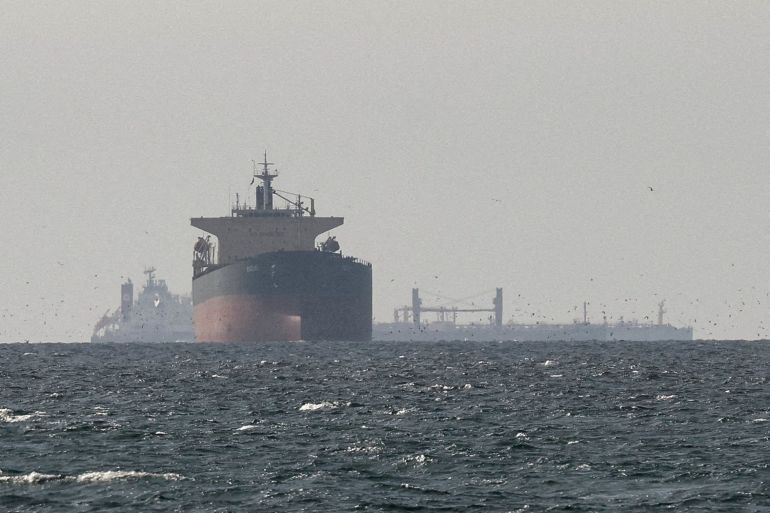
Iran has effectively closed the strait since the US-Israeli war began on February 28, permitting only a limited number of ships to pass after thorough vetting and authorization.
As of Saturday, approximately 3,200 vessels were stranded west of the strait due to the blockage, according to maritime intelligence firm Windward.
Anas Alhajji, former chief economist at NGP Energy Capital Management, suggested that non-Iranian ships would likely continue to avoid the strait despite the US military’s assurances, primarily due to elevated insurance premiums.
Alhajji also noted that ships might fear retaliation from Iran.
“Therefore, the Trump blockade of the Iranian ports is an actual blockade of the Hormuz Strait,” Alhajji informed Al Jazeera.
Analysts predict that the resulting increase in oil and gas prices would also drive up the cost of chemicals, fertilizers, and raw materials used in plastic manufacturing.
Cameron Johnson, a senior partner at Shanghai-based supply chain consultancy Tidalwave Solutions, anticipates that prices for many raw materials could rise within weeks if Trump implements his blockade threat.
Johnson told Al Jazeera, “The wild card really is the timeframe on this.”
He continued, “If this is a negotiating tactic – remember we still have eight or nine days left of the ceasefire – then it may not really matter. But if this prolongs itself into the end of the month and into the first week of May, you will see prices all over the world spike for raw materials.”
Deborah Elms, head of trade policy at the Hinrich Foundation in Singapore, warned that global supply chains could face “much worse” conditions under the blockade.
Elms explained to Al Jazeera, “Some of the problems are obvious, but many are not. As an example, fabrics will get more expensive.”
She added, “Packaging is already a challenge for firms. Many can’t get blister packs for pills or lids for consumer goods. We can expect consequences for food production later this year and into next year with fertiliser disruptions and lack of supply.”
Chad Norville, president of the oil and gas industry news site Rigzone, stated that Trump’s threat further erodes confidence in the strait’s situation ever returning to normal.
He noted that the mere threat is likely to increase insurance premiums for shipping and logistics companies and reduce the daily volume of trade through the strait.
Norville told Al Jazeera, “Disruptions to shipping and elevated risk in the region were already well established due to the conflict.”
He concluded, “This threat doesn’t create that baseline. It amplifies it by reinforcing uncertainty around one of the world’s most critical chokepoints.”
#EnergyCrisis #StraitOfHormuz #OilPrices #GlobalEconomy #IranBlockade #ShippingDisruption #SupplyChain #Geopolitics #MiddleEast #TrumpPolicy
US blockade of Iran would worsen global energy crisis, analysts say





Leave a Reply