

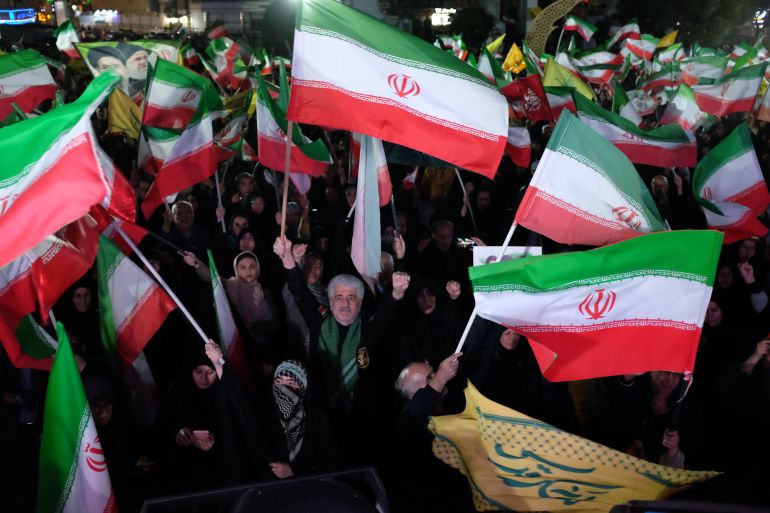
Tehran, Iran – Iranian authorities have stated that the United States must take further steps if an agreement is to be reached to end the ongoing conflict, while simultaneously calling on their supporters to maintain their presence and control in the streets.
Mohammad Bagher Ghalibaf, the parliament speaker who led the Iranian delegation, remarked that the U.S. delegation at Saturday’s extensive talks in Islamabad, Pakistan, “ultimately failed to earn the trust of the Iranian side in this round of negotiations.”
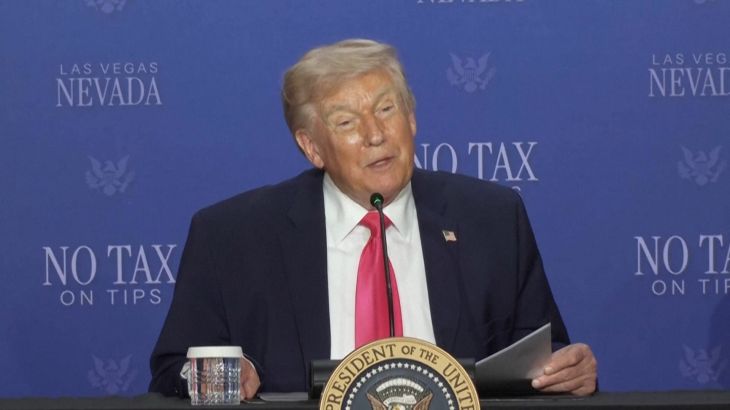
On Sunday, U.S. President Donald Trump announced that the U.S. Navy would immediately commence a “blockade of any and all ships attempting to enter or exit the Strait of Hormuz” in Iran’s southern waters. He further stated that the U.S. military remains “locked and loaded” and is prepared to “finish up” Iran at the “appropriate moment.”
Iranian authorities on Sunday welcomed the delegation’s refusal to concede to Washington’s primary demands, which included the elimination of nuclear enrichment on Iranian soil and an end to Iranian control over the Strait of Hormuz, portraying this stance as a clear act of defiance.
Judiciary chief Gholam-Hossein Mohseni-Ejei expressed gratitude to the delegation that traveled to Islamabad, asserting that they “protected the rights” of the Iranian government’s supporters, including paramilitary forces who have been gathering nightly in main squares, streets, and mosques across Tehran and other cities for over six weeks.
During the talks on Saturday night, state television broadcast footage of a member of the Islamic Revolutionary Guard Corps (IRGC) aerospace division addressing flag-waving supporters in downtown Tehran, urging them not to be worried.
“If the enemy does not understand, we will make them understand,” declared the man, clad in military attire and a black mask to obscure his identity, to cheers from the crowd. Some in the audience called for increased missile and drone attacks from the IRGC.
State television also contended that it was Trump, rather than Tehran, who sought to “restore his image” through the negotiations, and that his “excessive demands” were the cause of the talks’ failure.
The Ministry of Foreign Affairs stated that it had not anticipated reaching an agreement after just a single day of negotiations.
Several lawmakers in the hardliner-controlled parliament expressed satisfaction that the talks did not produce results, believing that Iran held the advantage in the conflict.
Hamidreza Haji-Babaei, the deputy parliament speaker, asserted that the only acceptable outcome for the establishment’s supporters in the streets would be a United Nations Security Council resolution signaling “surrender” for the U.S. and leading to the lifting of sanctions against Iran and its leaders.
Amir Hossein Sabeti, a Tehran lawmaker associated with the hardline Paydari faction, commended the negotiating team for “not retreating from red lines” and declared that “there is no way left but to demonstrate resistance in the field against these evildoers and demons.”
This development follows expressions of dismay from some pro-state voices regarding the sudden announcement overnight into Wednesday of a two-week ceasefire and direct negotiations aimed at ending the war with the U.S.
According to local media, the Iranian delegation to Islamabad comprised over 85 members, including dozens of representatives from state-affiliated media and analysts close to various factions, a move seemingly intended to alleviate internal concerns.
Beyond Ghalibaf, a former IRGC commander credited with advancing Iran’s missile program, key members of the team included Foreign Minister Abbas Araghchi, hardline diplomat Ali Bagheri Kani, Defence Council head and former security chief Ali Akbar Ahmadian, and moderate central bank chief Abdolnasser Hemmati.
The Saturday talks indicated that a diplomatic breakthrough was not imminent and that further escalation was probable, even without an immediate return to full-scale fighting.
Ebrahim Azizi, head of the national security commission of Iran’s parliament, told state television on Sunday afternoon that Trump’s statements following the negotiations, including his announced naval blockade and new threats, were “just excessive talk” and merely “his wishes spoken out loud.”
The IRGC has threatened to respond with full force to any passage of military vessels through the Strait of Hormuz. It also refuted the U.S. military’s announcement during the talks that two U.S. warships had transited the strait in preparation for an operation to clear naval mines obstructing the strategic waterway.
Russian President Vladimir Putin informed Iranian President Masoud Pezeshkian in a Sunday phone call that he remains prepared to diplomatically facilitate a peace settlement in the Middle East.
Pezeshkian, primarily focused on domestic affairs, has voiced support for the continuity of the establishment and for Mojtaba Khamenei, the supreme leader who has not been publicly seen or heard from beyond written statements since Israel and the U.S. initiated the war on February 28. His government announced that schools and universities would conduct classes online, utilizing a limited local intranet, until further notice.
Iran’s economy continues to grapple with chronic inflation, with further job losses projected for 2026, as the state persists in enforcing a near-total internet shutdown.
#Iran #USIranTensions #StraitOfHormuz #NuclearDeal #MiddleEastConflict #IRGC #Diplomacy #Sanctions #Geopolitics #Tehran


Leave a Reply