

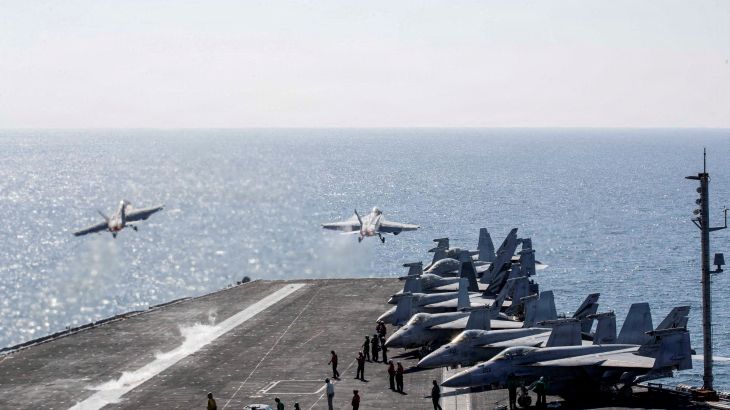
The United States military has announced that its blockade of Iranian ports is now “fully implemented,” effectively bringing all economic trade by sea into and out of Iran to a “complete halt.”
According to a social media post by US Central Command (CENTCOM), the military body overseeing operations in the Middle East and leading the conflict with Iran, the blockade is being rigorously enforced against vessels of all nationalities attempting to access or depart from Iran’s coastal areas and ports.
Admiral Brad Cooper, CENTCOM Commander, stated late on Tuesday that approximately 90% of Iran’s economy relies on international maritime trade. He claimed that within just 36 hours of the blockade’s implementation, US forces had successfully stopped all sea-based economic trade with Iran.
CENTCOM reported that over 10,000 personnel from the Navy, Marines, and Air Force are involved in the operation. In the initial 24 hours, six merchant ships reportedly complied with US directives to turn around and return to an Iranian port. Reuters further detailed that a US Navy destroyer intercepted two oil tankers attempting to leave Iran on Tuesday, a day after the blockade began, ordering them to reverse course. These tankers had departed from Iran’s Chabahar port in the Gulf of Oman and were contacted by the US warship via radio, an official anonymously confirmed to Reuters.
US President Donald Trump reportedly hopes this blockade will compel Tehran to accept Washington’s conditions for ending the US-Israel war on Iran. The blockade was announced following the collapse of weekend negotiations between US and Iranian representatives in Pakistan, which had previously led to a ceasefire announcement. CENTCOM confirmed that no ships have breached the US blockade since its activation on Monday at 10 AM Washington, DC time (14:00 GMT).
Abas Aslani, a senior research fellow at the Center for Middle Eastern Strategic Studies in Tehran, suggested on Wednesday that Iranians perceive the US is now hinting at renewed peace talks. This, he believes, is an attempt to mitigate the blockade’s impact on the global oil market. Oil prices had initially surged past $100 per barrel before slightly receding amidst hopes of further discussions between the two nations.
Tehran views the blockade as a violation of the existing, albeit “very fragile,” ceasefire, a development that Aslani warns “can complicate the situation.” The international community now awaits Iran’s official reaction to these significant developments.
#IranBlockade #USMilitary #EconomicWarfare #MiddleEast #CENTCOM #OilPrices #Geopolitics #MaritimeTrade #IranCrisis #InternationalRelations





Leave a Reply