


In the tense final hours leading up to a United States-Iran ceasefire, which was secured early Wednesday in the Middle East, the nearly six-week-long conflict that had rattled the world threatened to escalate to even more prolonged and devastating levels. US President Donald Trump had issued increasingly dire warnings, including threats that some considered genocidal, stating he would obliterate Iran’s infrastructure and that an “entire civilization” would perish if Tehran failed to comply with his deadline to reopen the Strait of Hormuz by 8 pm Washington, DC, time on Tuesday (midnight GMT). Just a day prior, Trump had also threatened to bomb Iran “back to the Stone Ages.” World leaders reacted with alarm to his rhetoric, global markets plummeted, and some observers began to question whether the Trump White House might even be considering the use of nuclear weapons. Ultimately, throughout a tense Tuesday, last-minute diplomatic efforts, mediated by Pakistan, resulted in a two-week ceasefire, secured less than 90 minutes before Trump’s self-imposed deadline for launching large-scale, devastating attacks on Iran. Israel also consented to halt its attacks but clarified that Lebanon was not part of the agreement. The truce was announced after both parties agreed to cease all hostilities and reopen the Strait of Hormuz. Negotiations for a permanent settlement are scheduled to resume on Friday in Islamabad, the Pakistani capital. On Wednesday, Trump suggested in a Truth Social post that the ceasefire could herald a “Golden Age for the Middle East.” However, throughout Tuesday, as Trump’s deadline drew near, the region and the world remained on high alert. Threats, counterthreats, escalating attacks from both sides, and intense diplomatic efforts converged, leaving it uncertain whether negotiations or further devastation would prevail. Here are the key moments from the tense final hours leading up to this fragile ceasefire:
12:06 GMT, Tuesday – Trump’s Threat to Iran’s Civilization
On Tuesday morning, Trump warned in a post on his social media platform, Truth Social, that Washington would unleash devastating strikes on Iranian bridges, power plants, and other civilian infrastructure. Trump even declared that “a whole civilization will die tonight, never to be brought back again” – a statement that legal and human rights experts characterized as a “genocidal” threat. “We have a plan, because of the power of our military, where every bridge in Iran will be decimated… where every power plant in Iran will be out of business, burning, exploding, and never to be used again,” he stated.
15:21 GMT, Tuesday – US Strikes Hit Kharg Island
Iran’s semi-official Mehr news agency confirmed reports that Kharg Island, home to Iran’s primary oil exporting facilities, had been struck, but added that there was no damage to infrastructure and the situation was under control.
15:40 GMT, Tuesday – China, Russia Veto Security Council Resolution on Strait of Hormuz
During a vote in the United Nations Security Council, China and Russia vetoed a Bahraini resolution that encouraged states to coordinate efforts to protect commercial shipping in the Strait of Hormuz. Eleven countries on the 15-member council voted in favor of the resolution, two abstained, and two voted against it – China and Russia, both permanent members with veto power in the UN’s highest decision-making body. Moscow and Beijing argued that the draft was one-sided and unfair to Tehran. China’s UN ambassador, Fu Cong, stated that proceeding with the proposal while the US was issuing threats about the potential destruction of an entire civilization would have sent the wrong signal.
16:54 GMT, Tuesday – Qatar and UAE Issue Elevated Alerts
Qatar’s Ministry of Defense announced it “successfully intercepted a missile attack” targeting the country. This incident followed an “elevated” threat alert and subsequent reports of missile interception sounds over the capital, Doha. Nearly half an hour earlier, the United Arab Emirates also reported a barrage of missile and drone attacks on its territory.
18:23 GMT, Tuesday – Iran’s Envoy to Pakistan Reports ‘Step Forward’ After ‘Sensitive Stage’
Reza Amiri Moghadam stated in a post on X that “as of now,” there has been “a step forward from [a] critical, sensitive stage.” “In the next stage, respect and comity should replace rhetoric and redundancy. Stay more tuned,” the Iranian ambassador to Pakistan added. Earlier in the day, Moghadam had referred to Pakistan’s “positive and productive endeavors” towards peace and indicated that talks had entered a “critical” stage – marking the first official confirmation from Iran that it was engaged in formal negotiations with the US.
19:17 GMT, Tuesday – Pakistan’s PM Asks Trump to Extend Deadline
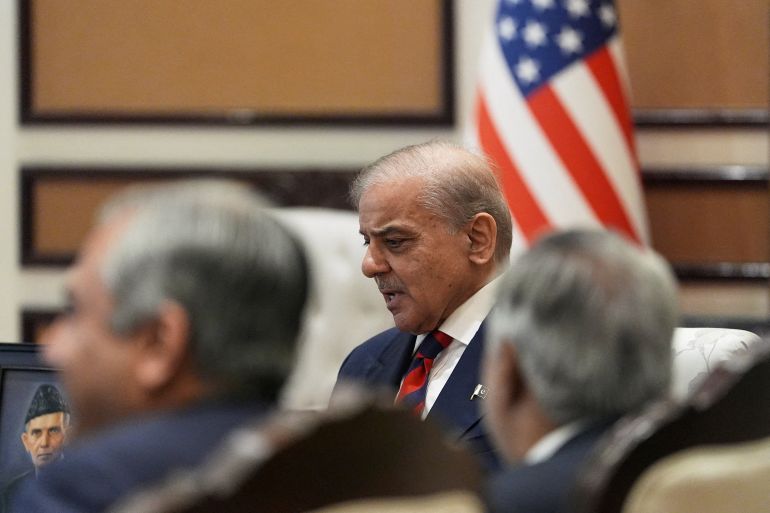
Pakistani Prime Minister Shehbaz Sharif appealed to Trump to extend his deadline for an Iran deal by two weeks and urged Iran to open the Strait of Hormuz during the same period, emphasizing that ongoing diplomatic efforts were promising and deserved a chance. “Diplomatic efforts for a peaceful settlement of the ongoing war in the Middle East are progressing steadily, strongly, and powerfully, with the potential to lead to substantive results in the near future,” Sharif wrote in a post on X. “To allow diplomacy to run its course, I earnestly request President Trump to extend the deadline for two weeks.” Sharif also called on Tehran to open the Strait of Hormuz for the same two weeks “as a goodwill gesture.”
20:25 GMT, Tuesday – Iran Threatens to Block Regional Oil and Gas
Ebrahim Zolfaghari, a spokesperson for the Iranian military’s Khatam al-Anbiya Central Headquarters, warned that the country would target the energy infrastructure of the US and its Gulf allies in the region, Fars news agency reported. The official stated that Iran would aim to deprive the region of oil and gas for years, with the objective of forcing US forces and their partners to withdraw.
20:41 GMT, Tuesday – US and Israeli Air Strikes on Energy Plant in Southwest Iran
The deputy security officer of Khuzestan province announced that the Amirkabir Petrochemical Plant in the port city of Mahshahr was struck in an airstrike, Mehr reported, adding that local authorities were assessing the extent of the damage and potential casualties.
22:45 GMT, Tuesday – Trump Announces Temporary Ceasefire
With less than an hour and a half remaining until his deadline for the destruction of Iranian “civilization,” Trump announced a two-week ceasefire with Iran following talks with Sharif and Pakistan’s military chief, Asim Munir. He stated that the ceasefire would be “double-sided” and that Washington had received a “workable” 10-point proposal from Iran. Twenty-five minutes later, Iranian Foreign Minister Abbas Araghchi confirmed Trump’s announcement and added that Tehran would abide by the temporary truce if attacks on its territory were halted. In a post on X, Sharif invited Iranian and US delegations to Islamabad on Friday “to further negotiate for a conclusive agreement to settle all disputes.”
04:01 GMT, Wednesday – Trump Says Ceasefire Could Lead to ‘Golden Age’ for Middle East
A week earlier, Trump had threatened to bomb Iran “back to the Stone Ages.” Hours after he announced the two-week ceasefire with Iran, his tone had notably shifted. “A big day for World Peace! Iran wants it to happen, they’ve had enough! Likewise, so has everyone else!” he wrote on Truth Social. “Just like we are experiencing in the U.S., this could be the Golden Age of the Middle East!!!”
#USIranCeasefire #MiddleEastPeace #Diplomacy #StraitOfHormuz #DonaldTrump #IranCrisis #PakistanMediation #Geopolitics #InternationalRelations #GlobalSecurity





Leave a Reply